Lebensmitteldaten können auf Englisch angezeigt werden, wenn keine Übersetzung verfügbar ist.

TurnipErnährungsreferenz
Gemüse

Turnip

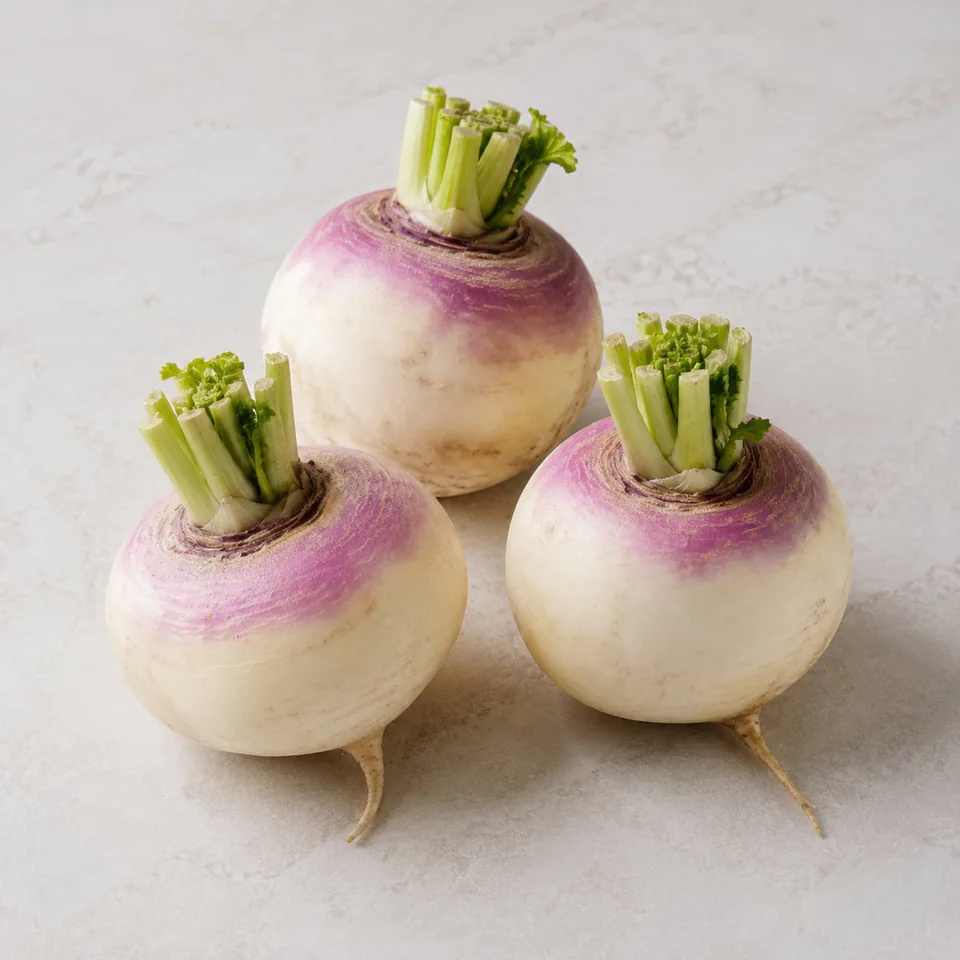
Turnip is a mild, crunchy root vegetable in the Brassica family, low in calories and commonly eaten raw, roasted, mashed, or added to soups and stews.

34
kcalpro 100g
Kohlenhydrate
7.27g
Protein
0.95g
Fett
0.12g

Nährwertangaben

Pro 100 Gramm

Referenzwerte
Messgrundlage
Lebensmittelzustand
Raw
Essbarer Anteil
Peeled root, skin removed
Messgrundlage
Per 100 g raw edible portion; source portion: 100 g; no volume conversion
Energie (kcal)
34 kcal
Protein1
0.953125 g
Kohlenhydrate1
7.27498 g
Fett1
0.1188 g
Ballaststoffe1
1.915 g
Zucker1
5.091 g
Gesättigte Fettsäuren
0.011 g
Natrium1
12.8 mg
Weitere Nährstoffe25
Energie (kJ)
142.2 kJ
Transfett2
0 g
Cholesterin2
0 mg
Kalzium1
32.7 mg
Kalium1
262.1 mg
Magnesium1
10.39 mg
Eisen31
<0.25 mg
Zink1
0.1561 mg
Vitamin B1
0.04 mg
Vitamin B2
0.03 mg
Vitamin B3
0.4 mg
Vitamin B5
0.2 mg
Vitamin B6
0.118 mg
Vitamin B71
0.9563 µg
Vitamin B9 (Folat)1
60.24 µg
Vitamin B122
0 µg
Vitamin C1
26.78 mg
Vitamin D2
0 µg
Vitamin K4
0 µg
Vitamin A (RAE)
0 µg
Retinol2
0 µg
Beta-Carotin2
0 µg
Alpha-Carotin2
0 µg
Beta-Cryptoxanthin2
0 µg
Vitamin E (Alpha-Tocopherol)
0.03 mg
  1. Von der Quelle als null angenommen
  2. Unter der Bestimmungsgrenze
  3. Definition oder Quelle ausstehend zur Überprüfung
  1. Zusätzliche Datenquelle[1]

Datenquellen

2
  1. 1

    USDA FoodData Central, Foundation Foods, FDC 2747674

    2747674 · Foundation Foods April 2026; 2025-12-18

  2. 2

    U.S. Department of Agriculture, Agricultural Research Service

    170465 · SR Legacy April 2018; 2019-04-01

Über dieses Lebensmittel

Diese Nährwertreferenz verstehen

Turnip is a mild-flavored root vegetable from the Brassica family, related to cabbage, broccoli, and radish. Its round, creamy-white root has a crisp texture and a slightly peppery, earthy taste that softens and sweetens with cooking. Turnips can be eaten raw in salads, roasted, mashed, or simmered in soups and stews, and their leafy greens are also edible.

Nutritionally, turnips are low in calories and fat while providing dietary fiber, vitamin C, and small amounts of minerals such as potassium and calcium. Because they add bulk and flavor for relatively few calories, they are a useful vegetable in balanced and calorie-conscious meals.

Plane deine Portion

Wie viel ist in Ihrer Portion von Turnip?

Nutrition values are reported per 100 g of raw edible turnip. A typical 1-cup serving of cubed turnip weighs about 130 g and provides roughly 44 kcal, while a medium turnip weighs about 122 g. Use the serving sizes below to estimate portions when logging.

Berechnet aus der Referenz pro 100 g. Werte sind gerundet.
PortionGewichtKalorienKohlenhydrateProteinFett
100 g100 g34 kcal7.3 g1 g0.1 g
1 cup cubed130 g44.2 kcal9.5 g1.2 g0.2 g
1 medium122 g41.5 kcal8.9 g1.2 g0.1 g

Verwenden Sie das Gewicht des essbaren Anteils im oben gezeigten Lebensmittelzustand.

Energie (kcal)
34 kcal
Energie (kJ)
142.2 kJ
Protein1
0.953125 g
Kohlenhydrate1
7.27498 g
Fett1
0.1188 g
Ballaststoffe1
1.915 g
Zucker1
5.091 g
Gesättigte Fettsäuren
0.011 g
Transfett2
0 g
Cholesterin2
0 mg
Natrium1
12.8 mg
Kalzium1
32.7 mg
Kalium1
262.1 mg
Magnesium1
10.39 mg
Eisen31
<0.25 mg
Zink1
0.1561 mg
Vitamin B1
0.04 mg
Vitamin B2
0.03 mg
Vitamin B3
0.4 mg
Vitamin B5
0.2 mg
Vitamin B6
0.118 mg
Vitamin B71
0.9563 µg
Vitamin B9 (Folat)1
60.24 µg
Vitamin B122
0 µg
Vitamin C1
26.78 mg
Vitamin D2
0 µg
Vitamin K4
0 µg
Vitamin A (RAE)
0 µg
Retinol2
0 µg
Beta-Carotin2
0 µg
Alpha-Carotin2
0 µg
Beta-Cryptoxanthin2
0 µg
Vitamin E (Alpha-Tocopherol)
0.03 mg

Fragen und Antworten

Turnip Ernährungs-FAQ

How many calories are in a turnip?

A 100 g serving of raw turnip has about 34 kcal. One cup of cubed turnip (about 130 g) provides roughly 44 kcal.

Are turnips good for weight loss?

Yes. Turnips are low in calories and fat while providing fiber and water, which can help with fullness, making them a useful food in calorie-controlled meal plans.

How do you eat turnips?

Turnips can be eaten raw in salads, roasted, mashed, or added to soups and stews; cooking softens their texture and mellows their flavor.