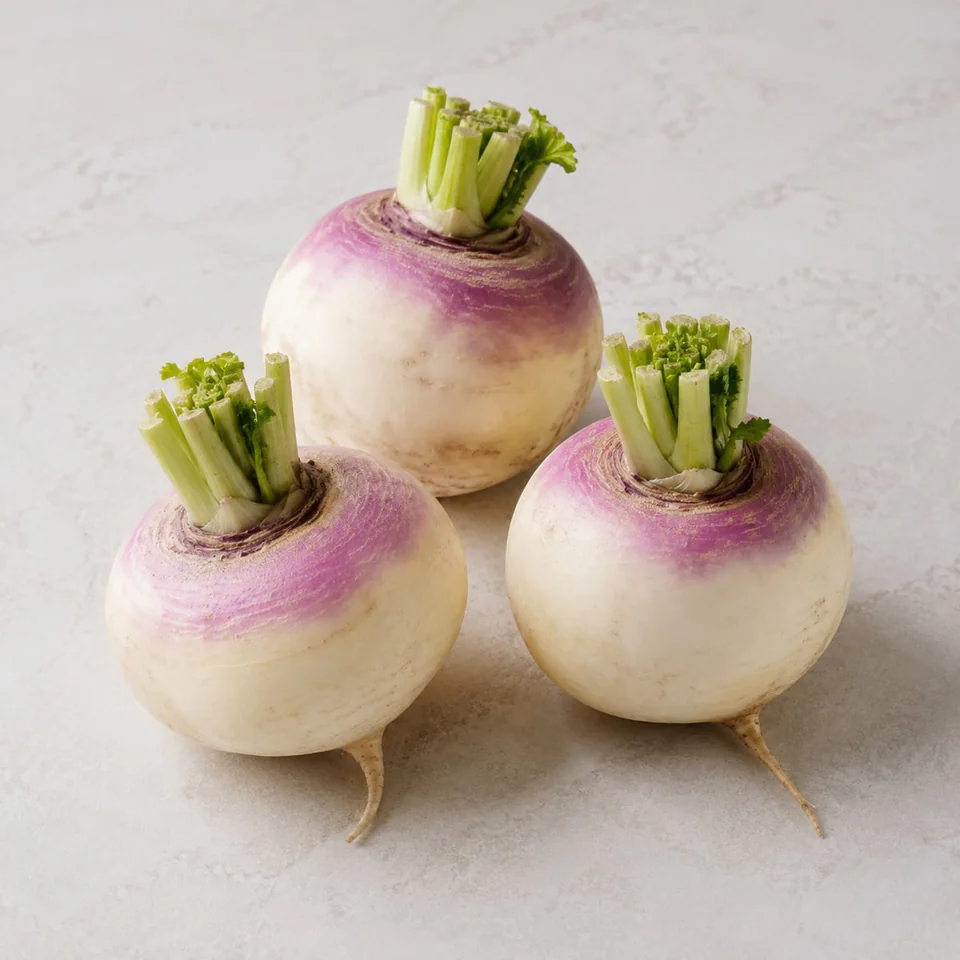
Turnip is a mild-flavored root vegetable from the Brassica family, related to cabbage, broccoli, and radish. Its round, creamy-white root has a crisp texture and a slightly peppery, earthy taste that softens and sweetens with cooking. Turnips can be eaten raw in salads, roasted, mashed, or simmered in soups and stews, and their leafy greens are also edible.
Nutritionally, turnips are low in calories and fat while providing dietary fiber, vitamin C, and small amounts of minerals such as potassium and calcium. Because they add bulk and flavor for relatively few calories, they are a useful vegetable in balanced and calorie-conscious meals.
Plan your portion
How much is in your serving of Turnip?
Nutrition values are reported per 100 g of raw edible turnip. A typical 1-cup serving of cubed turnip weighs about 130 g and provides roughly 44 kcal, while a medium turnip weighs about 122 g. Use the serving sizes below to estimate portions when logging.
Calculated from the per-100-g reference. Values are rounded.
Serving
Weight
Calories
Carbs
Protein
Fat
100 g
100 g
34 kcal
7.3 g
1 g
0.1 g
1 cup cubed
130 g
44.2 kcal
9.5 g
1.2 g
0.2 g
1 medium
122 g
41.5 kcal
8.9 g
1.2 g
0.1 g
Use the weight of the edible portion in the food state shown above.
A 100 g serving of raw turnip has about 34 kcal. One cup of cubed turnip (about 130 g) provides roughly 44 kcal.
Are turnips good for weight loss?
Yes. Turnips are low in calories and fat while providing fiber and water, which can help with fullness, making them a useful food in calorie-controlled meal plans.
How do you eat turnips?
Turnips can be eaten raw in salads, roasted, mashed, or added to soups and stews; cooking softens their texture and mellows their flavor.