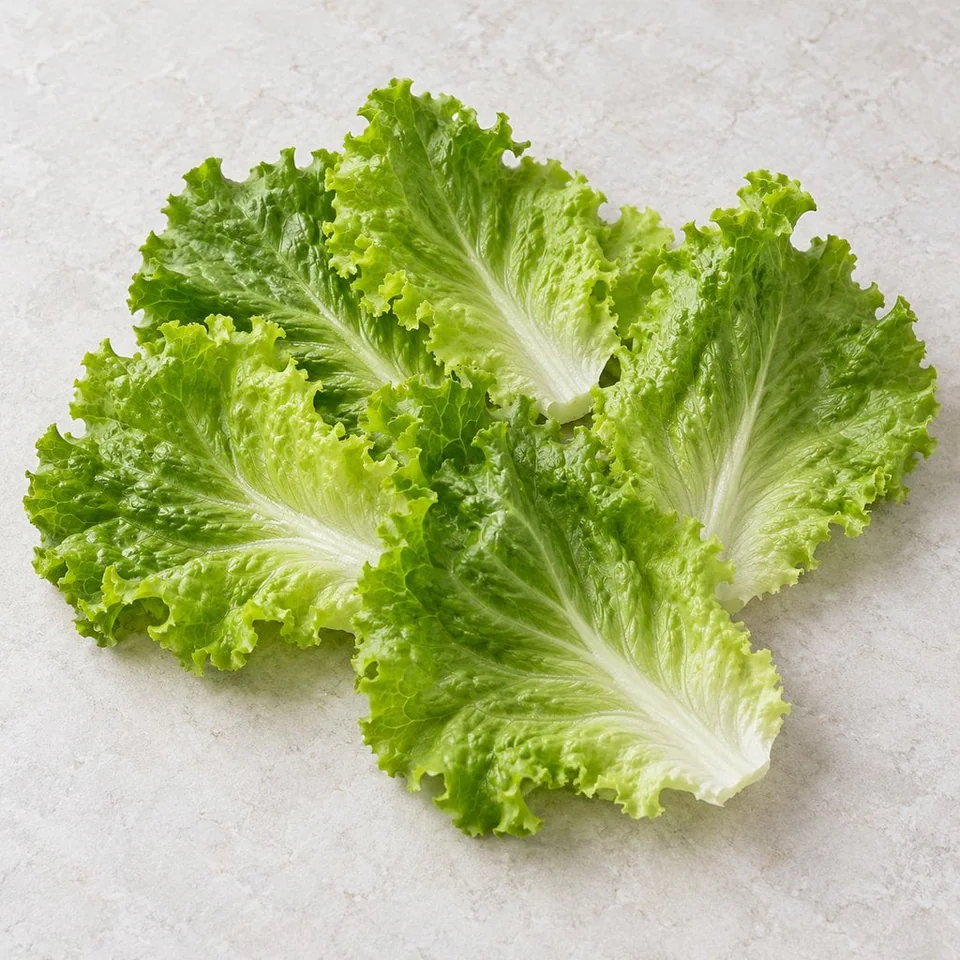
Lettuce is a crisp, leafy green vegetable eaten raw in salads, wraps, and sandwiches. Per 100 g it provides 20 calories with 3.7 g carbs and 1.3 g fiber.
Lettuce is a crisp, leafy green vegetable eaten almost exclusively raw. It is the base of most salads and is also used in wraps, sandwiches, and burgers. Varieties include iceberg, romaine, and loose-leaf types.
Nutritionally, lettuce is very low in calories and mostly water. Per 100 g it provides about 20 kcal, 3.7 g of carbohydrates, 0.9 g of protein, and 0.1 g of fat, with 1.3 g of dietary fiber, 23 mg of sodium, and 31 mg of calcium.
Lettuce leaves are light, so a large volume weighs little and contributes few calories. For accurate tracking, weigh the leaves as used or measure by the cup, and use the serving sizes below.
Plan your portion
How much is in your serving of Lettuce?
Nutrition values are reported per 100 g. A typical 1 cup of shredded lettuce (about 47 g) provides roughly 9 kcal. Use the serving sizes below to estimate portions when logging.
Calculated from the per-100-g reference. Values are rounded.
Serving
Weight
Calories
Carbs
Protein
Fat
100 g
100 g
20 kcal
3.7 g
0.9 g
0.1 g
1 cup shredded
47 g
9.4 kcal
1.7 g
0.4 g
0 g
2 cups shredded
94 g
18.8 kcal
3.5 g
0.9 g
0.1 g
Use the weight of the edible portion in the food state shown above.
Energy (kcal)
20 kcal
Energy (kJ)
83.7 kJ
Protein
0.92 g
Carbohydrates
3.69 g
Fat
0.1 g
Dietary fiber
1.3 g
Sugars
1.1 g
Saturated fat
0.026 g
Cholesterol
0 mg
Sodium
23 mg
Calcium
31 mg
Potassium
249 mg
Magnesium
11 mg
Iron
0.26 mg
Zinc
0.26 mg
Vitamin B1
0.066 mg
Vitamin B2
0.064 mg
Vitamin B3
0.323 mg
Vitamin B6
0.062 mg
Vitamin B9 (folate)
38 µg
Vitamin B12
0 µg
Vitamin C
8 mg
Vitamin D
0 µg
Vitamin A (RAE)
302 µg
Retinol
0 µg
Beta-carotene
3620 µg
Alpha-carotene
1 µg
Beta-cryptoxanthin
0 µg
Vitamin E (alpha-tocopherol)
0.17 mg
Vitamin K1 (phylloquinone)
73.9 µg
Questions and answers
Lettuce nutrition FAQ
How many calories are in lettuce?
Lettuce provides about 20 calories per 100 g. A typical 1 cup of shredded lettuce (about 47 g) provides roughly 9 calories.
Is lettuce mostly water?
Yes. Lettuce is mostly water, which is why it is so low in calories. Per 100 g it provides about 20 kcal.
Which lettuce is most nutritious?
Darker leafy varieties such as romaine tend to provide more nutrients than iceberg, though all lettuce is low in calories and high in water.