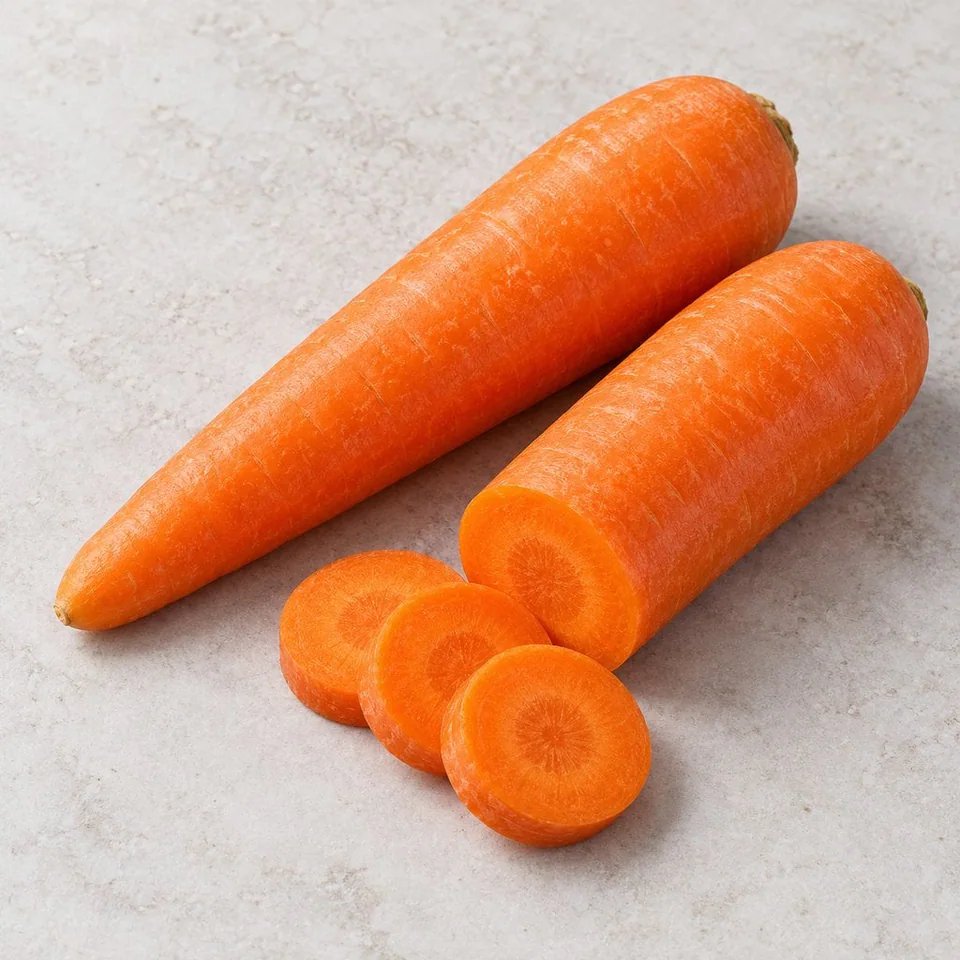
Carrots are crisp, sweet root vegetables enjoyed raw or cooked in dishes worldwide. Per 100 g they provide 41 calories with 9.6 g carbs and 2.8 g fiber.
Carrots are crunchy root vegetables (Daucus carota) prized for their naturally sweet flavor and bright orange color. They are eaten raw as a snack, grated into salads, roasted, steamed, boiled, or simmered in soups and stews. Most carrots are orange, though purple, yellow, white, and red varieties also exist.
Nutritionally, raw carrots are low in calories and made up largely of water and carbohydrate. Per 100 g they provide about 41 kcal, 9.6 g of carbohydrates, 0.9 g of protein, and 0.2 g of fat, along with 2.8 g of dietary fiber, 69 mg of sodium, and 33 mg of calcium. Most of the carbohydrate is natural sugar, which gives carrots their sweetness.
Carrots are versatile in the kitchen. Cooking softens their texture and concentrates their sweetness, while juicing removes most of the fiber. For accurate tracking, weigh carrots raw or cooked according to how they are prepared and use the serving sizes below.
Plan your portion
How much is in your serving of Carrot?
Nutrition values are reported per 100 g. A typical medium carrot (about 61 g) provides roughly 25 kcal. Use the serving sizes below to estimate portions when logging.
Calculated from the per-100-g reference. Values are rounded.
Serving
Weight
Calories
Carbs
Protein
Fat
100 g
100 g
41 kcal
9.6 g
0.9 g
0.2 g
1 medium carrot
61 g
25 kcal
5.8 g
0.6 g
0.1 g
1 cup chopped
128 g
52.5 kcal
12.3 g
1.2 g
0.3 g
Use the weight of the edible portion in the food state shown above.
A 100 g serving of raw carrot provides about 41 calories, and one medium carrot (about 61 g) provides roughly 25 calories.
Are carrots high in fiber?
Carrots provide about 2.8 g of dietary fiber per 100 g. They are a low-calorie, high-water vegetable that contributes fiber as part of a varied diet.
Are carrots better raw or cooked?
Both are nutritious. Raw carrots stay crunchy and keep their fiber, while cooking softens them and brings out their natural sweetness. Weigh them by preparation method to keep logging accurate.