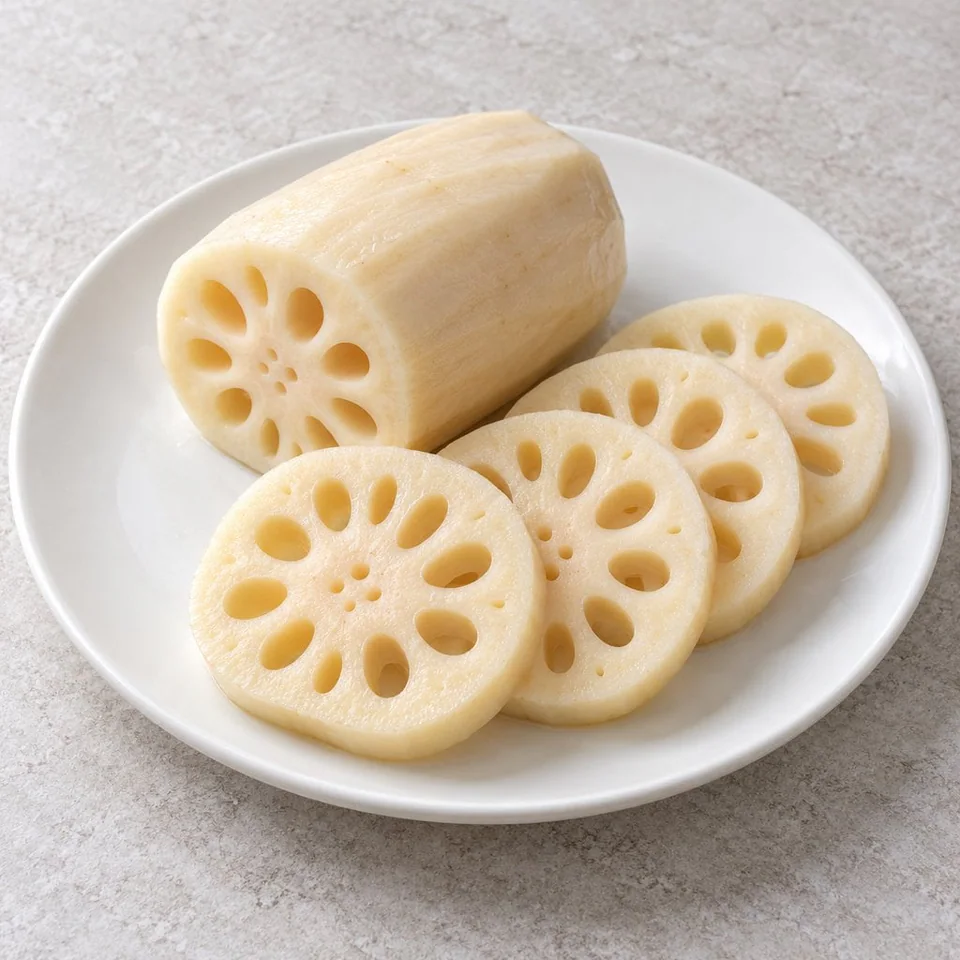
Lotus root is the crisp, crunchy rhizome of the lotus plant, with a lacy pattern of holes, eaten cooked or raw. Per 100 g it provides 74 calories with 17.2 g carbs and 4.9 g fiber.
Lotus root is the edible rhizome of the lotus plant, with a crisp, crunchy texture and a distinctive pattern of air holes when sliced. It is used in Chinese, Japanese, and Southeast Asian cooking, stir-fried, braised, or simmered in soups, and can also be eaten raw.
Nutritionally, lotus root is a starchy vegetable that is higher in carbohydrate than leafy greens. Per 100 g it provides about 74 kcal, 17.2 g of carbohydrates, 2.6 g of protein, and 0.1 g of fat, with 4.9 g of dietary fiber, 40 mg of sodium, and 45 mg of calcium.
Lotus root stays crisp when briefly cooked and softens with longer simmering. For accurate tracking, weigh the peeled slices and use the serving sizes below.
Plan your portion
How much is in your serving of Lotus Root?
Nutrition values are reported per 100 g. A typical 1 cup of sliced lotus root (about 120 g) provides roughly 89 kcal. Use the serving sizes below to estimate portions when logging.
Calculated from the per-100-g reference. Values are rounded.
Serving
Weight
Calories
Carbs
Protein
Fat
100 g
100 g
74 kcal
17.2 g
2.6 g
0.1 g
1 cup sliced
120 g
88.8 kcal
20.7 g
3.1 g
0.1 g
1/2 cup sliced
60 g
44.4 kcal
10.3 g
1.6 g
0.1 g
Use the weight of the edible portion in the food state shown above.