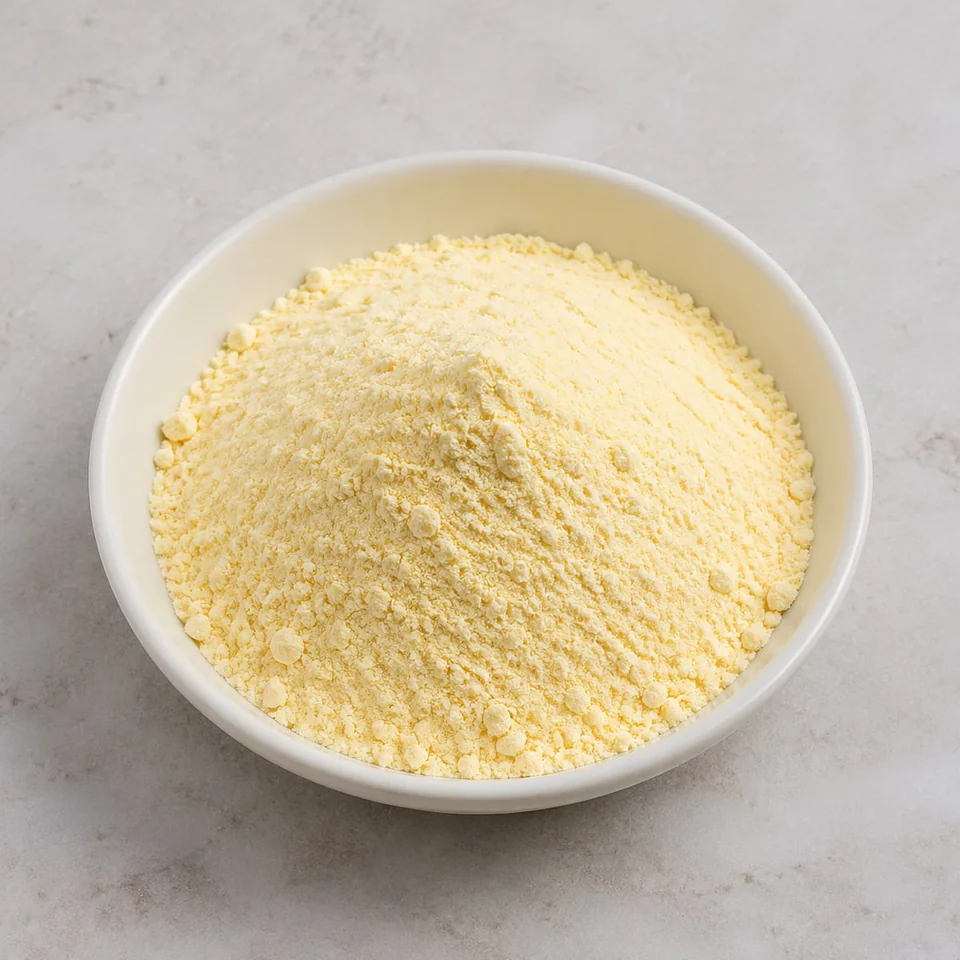
Whole egg powder is made by dehydrating whole eggs into a dry powder. It is used in baking, cooking, and food manufacturing, and can be reconstituted with water to replace fresh eggs.
Nutritionally, whole egg powder is concentrated because the water has been removed. Per 100 g it provides about 575 kcal, 1.9 g of carbohydrates, 48.1 g of protein, and 39.8 g of fat, with 485 mg of sodium and 220 mg of calcium.
A small amount of egg powder provides the nutrition of a whole egg. For accurate tracking, weigh the powder, and use the serving sizes below.
Planifica tu porción
¿Cuánto hay en tu porción de Whole Egg Powder?
Nutrition values are reported per 100 g. A typical 2 tbsp serving (about 14 g) provides roughly 81 kcal. Use the serving sizes below to estimate portions when logging.
Calculado a partir de la referencia por cada 100 g. Los valores están redondeados.
Porción
Peso
Calorías
Carbohidratos
Proteína
Grasa
100 g
100 g
575 kcal
1.9 g
48.1 g
39.8 g
2 tbsp
14 g
80.5 kcal
0.3 g
6.7 g
5.6 g
1 tbsp
7 g
40.3 kcal
0.1 g
3.4 g
2.8 g
Utilice el peso de la porción comestible en el estado del alimento mostrado arriba.
Energía (kcal)
575 kcal
Energía (kJ)
2410 kJ
Proteína
48.1 g
Carbohidratos
1.87 g
Grasa
39.8 g
Fibra dietética
0 g
Colesterol
1700 mg
Sodio
485 mg
Calcio
220 mg
Potasio
468 mg
Magnesio
44.6 mg
Hierro
6.97 mg
Zinc
5.02 mg
Vitamina D
9.7 µg
Preguntas y respuestas
Whole Egg Powder preguntas frecuentes sobre nutrición
How many calories are in whole egg powder?
Whole egg powder provides about 575 calories per 100 g. A typical 2 tbsp serving (about 14 g) provides roughly 81 calories.
Is whole egg powder high in protein?
Yes. Whole egg powder provides about 48.1 g of protein per 100 g, concentrated from the dehydrated eggs.
How do you use whole egg powder?
Whole egg powder is reconstituted with water to replace fresh eggs in baking and cooking.