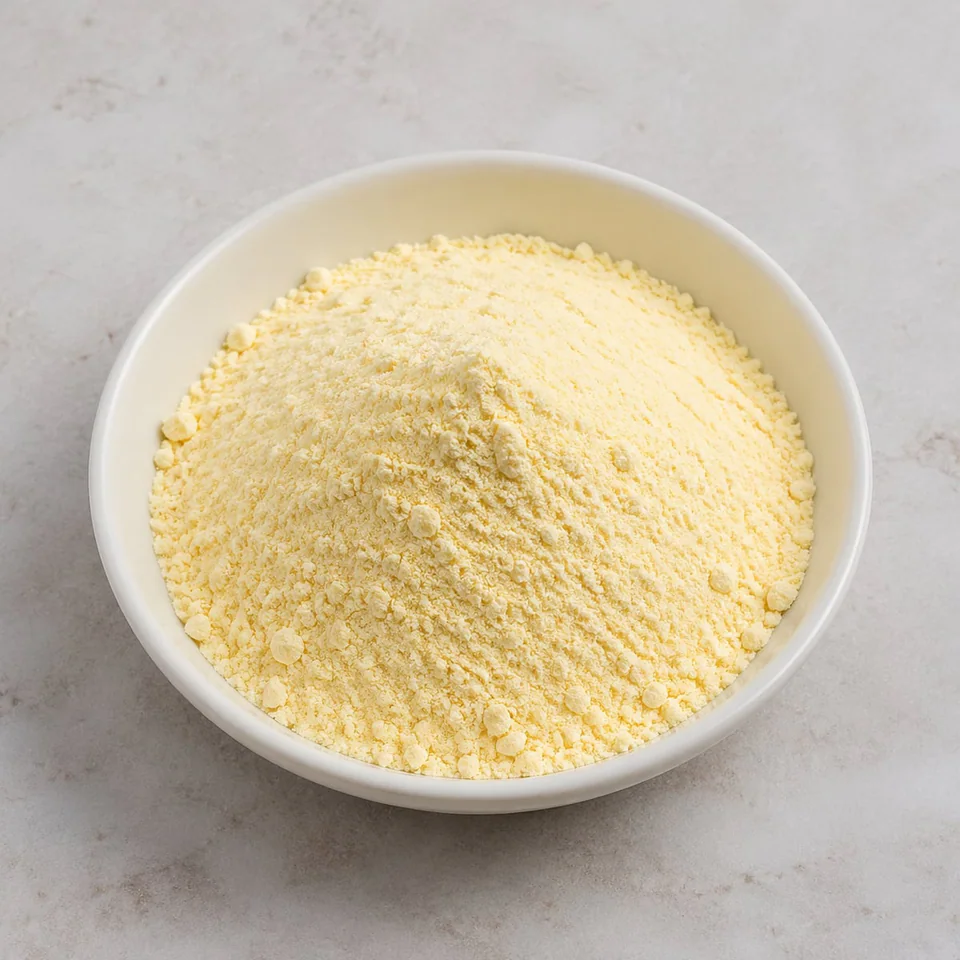
Whole egg powder is made by dehydrating whole eggs into a dry powder. It is used in baking, cooking, and food manufacturing, and can be reconstituted with water to replace fresh eggs.
Nutritionally, whole egg powder is concentrated because the water has been removed. Per 100 g it provides about 575 kcal, 1.9 g of carbohydrates, 48.1 g of protein, and 39.8 g of fat, with 485 mg of sodium and 220 mg of calcium.
A small amount of egg powder provides the nutrition of a whole egg. For accurate tracking, weigh the powder, and use the serving sizes below.
Plan your portion
How much is in your serving of Whole Egg Powder?
Nutrition values are reported per 100 g. A typical 2 tbsp serving (about 14 g) provides roughly 81 kcal. Use the serving sizes below to estimate portions when logging.
Calculated from the per-100-g reference. Values are rounded.
Serving
Weight
Calories
Carbs
Protein
Fat
100 g
100 g
575 kcal
1.9 g
48.1 g
39.8 g
2 tbsp
14 g
80.5 kcal
0.3 g
6.7 g
5.6 g
1 tbsp
7 g
40.3 kcal
0.1 g
3.4 g
2.8 g
Use the weight of the edible portion in the food state shown above.
Energy (kcal)
575 kcal
Energy (kJ)
2410 kJ
Protein
48.1 g
Carbohydrates
1.87 g
Fat
39.8 g
Dietary fiber
0 g
Cholesterol
1700 mg
Sodium
485 mg
Calcium
220 mg
Potassium
468 mg
Magnesium
44.6 mg
Iron
6.97 mg
Zinc
5.02 mg
Vitamin D
9.7 µg
Questions and answers
Whole Egg Powder nutrition FAQ
How many calories are in whole egg powder?
Whole egg powder provides about 575 calories per 100 g. A typical 2 tbsp serving (about 14 g) provides roughly 81 calories.
Is whole egg powder high in protein?
Yes. Whole egg powder provides about 48.1 g of protein per 100 g, concentrated from the dehydrated eggs.
How do you use whole egg powder?
Whole egg powder is reconstituted with water to replace fresh eggs in baking and cooking.