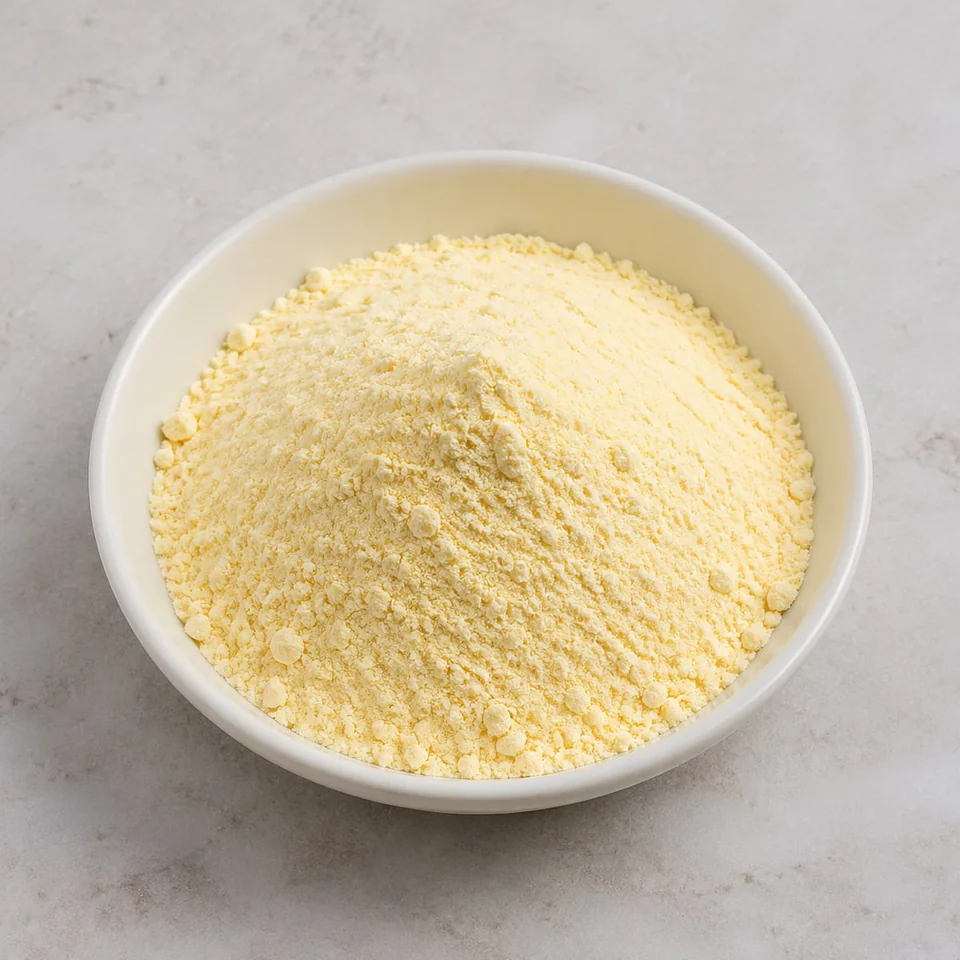
Whole egg powder is made by dehydrating whole eggs into a dry powder. It is used in baking, cooking, and food manufacturing, and can be reconstituted with water to replace fresh eggs.
Nutritionally, whole egg powder is concentrated because the water has been removed. Per 100 g it provides about 575 kcal, 1.9 g of carbohydrates, 48.1 g of protein, and 39.8 g of fat, with 485 mg of sodium and 220 mg of calcium.
A small amount of egg powder provides the nutrition of a whole egg. For accurate tracking, weigh the powder, and use the serving sizes below.
Pianifica la tua porzione
Quanto c'è nella tua porzione di Whole Egg Powder?
Nutrition values are reported per 100 g. A typical 2 tbsp serving (about 14 g) provides roughly 81 kcal. Use the serving sizes below to estimate portions when logging.
Calcolato dal riferimento per 100 g. I valori sono arrotondati.
Porzione
Peso
Calorie
Carboidrati
Proteine
Grassi
100 g
100 g
575 kcal
1.9 g
48.1 g
39.8 g
2 tbsp
14 g
80.5 kcal
0.3 g
6.7 g
5.6 g
1 tbsp
7 g
40.3 kcal
0.1 g
3.4 g
2.8 g
Usa il peso della parte edibile nello stato dell'alimento mostrato sopra.
Energia (kcal)
575 kcal
Energia (kJ)
2410 kJ
Proteine
48.1 g
Carboidrati
1.87 g
Grassi
39.8 g
Fibra alimentare
0 g
Colesterolo
1700 mg
Sodio
485 mg
Calcio
220 mg
Potassio
468 mg
Magnesio
44.6 mg
Ferro
6.97 mg
Zinco
5.02 mg
Vitamina D
9.7 µg
Domande e risposte
Whole Egg Powder FAQ sulla nutrizione
How many calories are in whole egg powder?
Whole egg powder provides about 575 calories per 100 g. A typical 2 tbsp serving (about 14 g) provides roughly 81 calories.
Is whole egg powder high in protein?
Yes. Whole egg powder provides about 48.1 g of protein per 100 g, concentrated from the dehydrated eggs.
How do you use whole egg powder?
Whole egg powder is reconstituted with water to replace fresh eggs in baking and cooking.