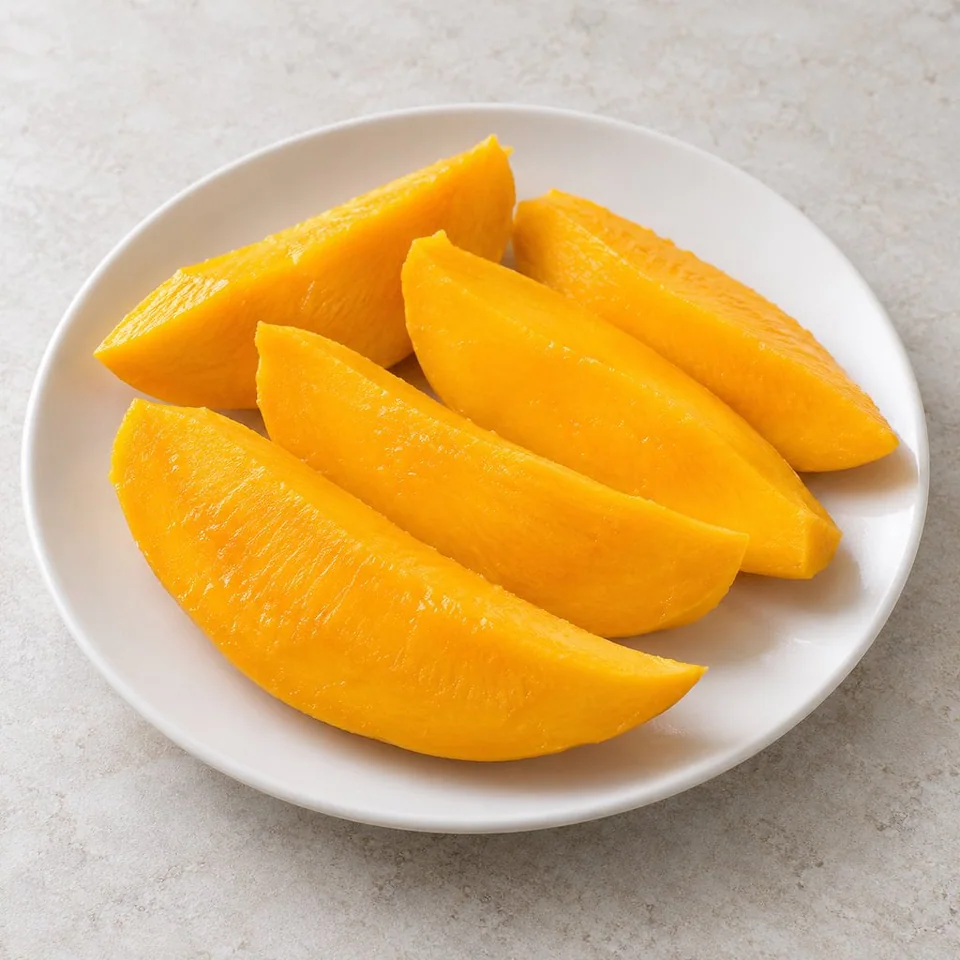
Mango is a sweet, juicy tropical fruit with golden-orange flesh and a large flat pit. Per 100 g it provides 60 calories with 15 g carbs and 1.6 g fiber.
Mango is a sweet, juicy tropical fruit with golden-orange flesh and a large flat pit. It is eaten fresh, and is also used in smoothies, salsas, desserts, and dried form.
Nutritionally, mango is mostly water and natural sugar. Per 100 g it provides about 60 kcal, 15 g of carbohydrates, 0.8 g of protein, and 0.4 g of fat, with 1.6 g of dietary fiber, 1 mg of sodium, and 11 mg of calcium.
Mango flesh is cut away from the skin and pit before eating. For accurate tracking, weigh the flesh without the skin and pit, and use the serving sizes below.
Plan your portion
How much is in your serving of Mango?
Nutrition values are reported per 100 g. A typical 1 cup of sliced mango (about 165 g) provides roughly 99 kcal. Use the serving sizes below to estimate portions when logging.
Calculated from the per-100-g reference. Values are rounded.
Serving
Weight
Calories
Carbs
Protein
Fat
100 g
100 g
60 kcal
15 g
0.8 g
0.4 g
1 cup sliced
165 g
99 kcal
24.7 g
1.4 g
0.6 g
1/2 cup sliced
82 g
49.2 kcal
12.3 g
0.7 g
0.3 g
Use the weight of the edible portion in the food state shown above.