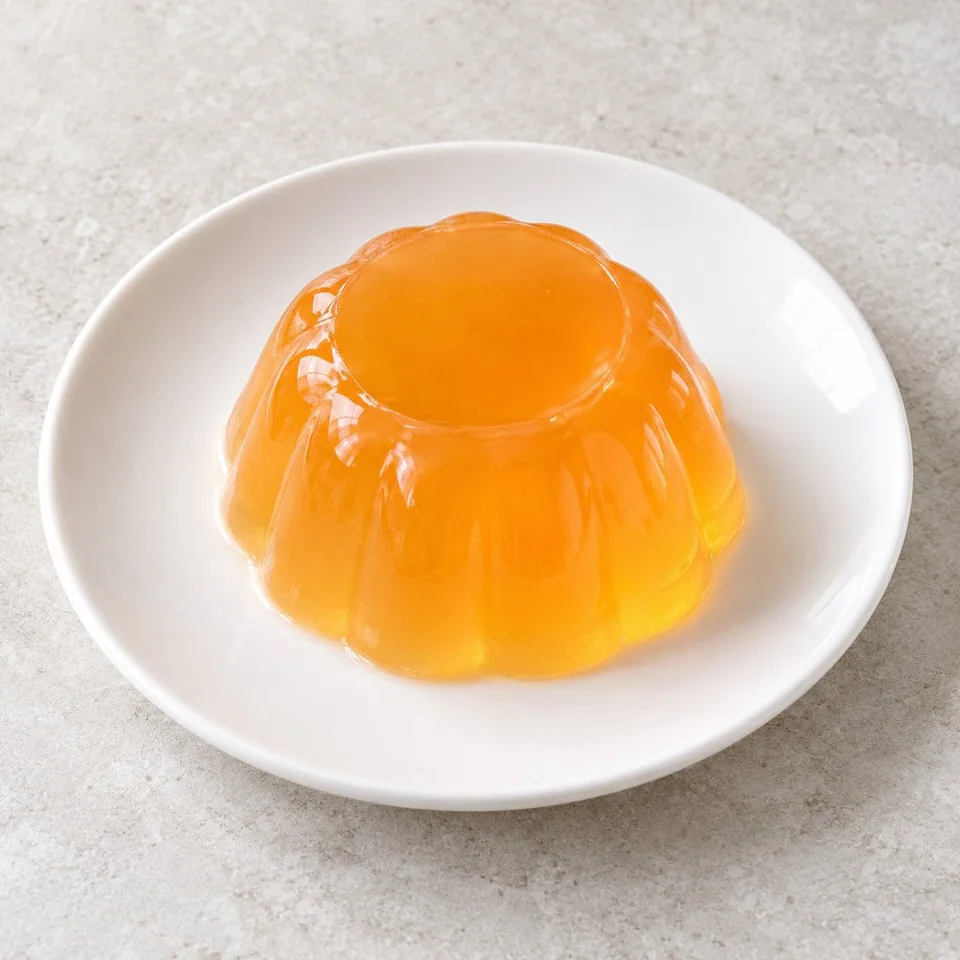
Jelly is a soft, wobbly gelatin dessert, usually fruit-flavored and sweetened. It is made by dissolving gelatin in hot water with sugar and flavoring, then chilling until set, and is often served in cups or as cubes.
Nutritionally, jelly is mostly water and sugar. Per 100 g it provides about 60 kcal and 14.2 g of carbohydrates, with 1.2 g of protein and no fat, along with 75 mg of sodium and 3 mg of calcium.
Sugar-free jelly replaces the sugar with low-calorie sweeteners. For accurate tracking, weigh or measure the serving, and use the serving sizes below.
Planifiez votre portion
Quelle quantité contient votre portion de Jelly?
Nutrition values are reported per 100 g. A typical 1/2 cup serving (about 135 g) provides roughly 81 kcal. Use the serving sizes below to estimate portions when logging.
Calculé à partir de la référence par 100 g. Les valeurs sont arrondies.
Portion
Poids
Calories
Glucides
Protéines
Graisse
100 g
100 g
60 kcal
14.2 g
1.2 g
0 g
1/2 cup
135 g
81 kcal
19.2 g
1.6 g
0 g
1 cup
270 g
162 kcal
38.3 g
3.3 g
0 g
Utilisez le poids de la partie comestible dans l'état de l'aliment indiqué ci-dessus.
Énergie (kcal)
60 kcal
Énergie (kJ)
251 kJ
Protéines
1.22 g
Glucides
14.2 g
Graisse
0 g
Fibres alimentaires
0 g
Sucres
13.5 g
Acides gras saturés
0 g
Cholestérol
0 mg
Sodium
75 mg
Calcium
3 mg
Potassium
1 mg
Magnésium
1 mg
Fer
0.02 mg
Zinc
0.01 mg
Vitamine B1
0 mg
Vitamine B2
0.006 mg
Vitamine B3
0.001 mg
Vitamine B6
0 mg
Vitamine B9 (folate)
1 µg
Vitamine B12
0 µg
Vitamine C
0 mg
Vitamine D
0 µg
Vitamine A (RAE)
0 µg
Rétinol
0 µg
Bêta-carotène
0 µg
Alpha-carotène
0 µg
Bêta-cryptoxanthine
0 µg
Vitamine E (alpha-tocophérol)
0 mg
Vitamine K1 (phylloquinone)
0 µg
Questions et réponses
Jelly FAQ nutrition
How many calories are in jelly?
Jelly provides about 60 calories per 100 g. A typical 1/2 cup serving (about 135 g) provides roughly 81 calories.
Is jelly high in sugar?
Jelly provides about 14.2 g of carbohydrates per 100 g, mostly from added sugar. Sugar-free versions use low-calorie sweeteners.
Is jelly fat-free?
Yes. Jelly contains no fat, providing about 60 calories per 100 g, mostly from sugar.