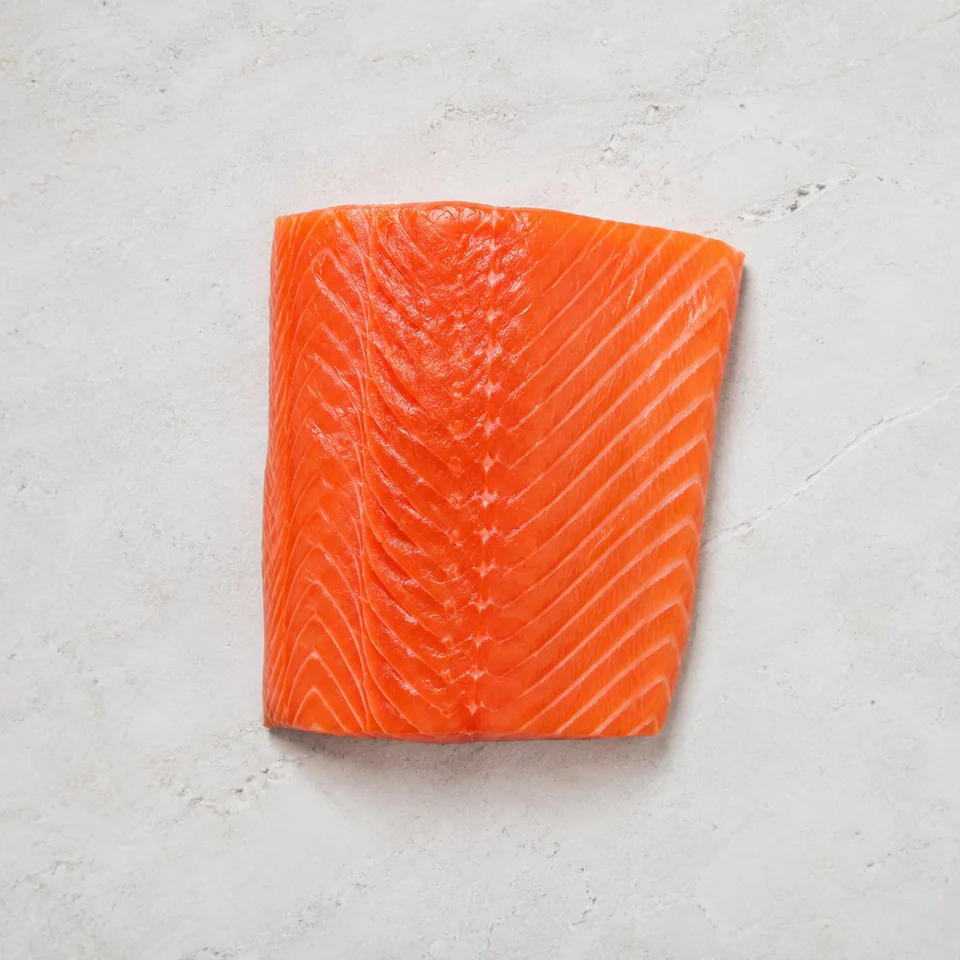
This record uses USDA data for raw, wild-caught sockeye salmon, rather than all salmon species or farming methods. Per 100 g of edible portion it provides about 130 kcal, 22.3 g protein, 4.94 g fat and 0.722 g saturated fat. The source reports 0 g carbohydrate by difference. The source also reports 0.211 g EPA and 0.326 g DHA per 100 g. These values do not describe smoked, cured or cooked salmon.
Planifica tu porción
¿Cuánto hay en tu porción de Salmon?
Nutrition values are reported per 100 g of raw salmon. A typical 4 oz fillet (about 113 g) provides roughly 147 kcal. Use the serving sizes below to estimate portions when logging.
Calculado a partir de la referencia por cada 100 g. Los valores están redondeados.
Porción
Peso
Calorías
Carbohidratos
Proteína
Grasa
100 g
100 g
130 kcal
0 g
22.3 g
4.9 g
4 oz fillet
113 g
146.9 kcal
0 g
25.2 g
5.6 g
8 oz fillet
227 g
295.1 kcal
0 g
50.6 g
11.2 g
Utilice el peso de la porción comestible en el estado del alimento mostrado arriba.
Energía (kcal)
130 kcal
Energía (kJ)
543.9 kJ
Proteína
22.3 g
Carbohidratos
0 g
Grasa
4.936 g
Fibra dietética
0 g
Grasa saturada
0.722 g
Colesterol
59.3 mg
Sodio
53.3 mg
Calcio
14.84 mg
Potasio
329.7 mg
Magnesio
26.15 mg
Hierro
0.4024 mg
Zinc
0.4246 mg
Vitamina B12
5.16 µg
Retinol
42.81 µg
Preguntas y respuestas
Salmon preguntas frecuentes sobre nutrición
How many calories are in salmon?
Salmon provides about 130 calories per 100 g. A typical 4 oz fillet (about 113 g) provides roughly 147 calories.
Is salmon high in protein?
Yes. Salmon provides about 22.3 g of protein per 100 g.
Is salmon high in omega-3?
The cited raw, wild-caught sockeye salmon record reports 0.211 g EPA and 0.326 g DHA per 100 g. These are omega-3 fatty acids.