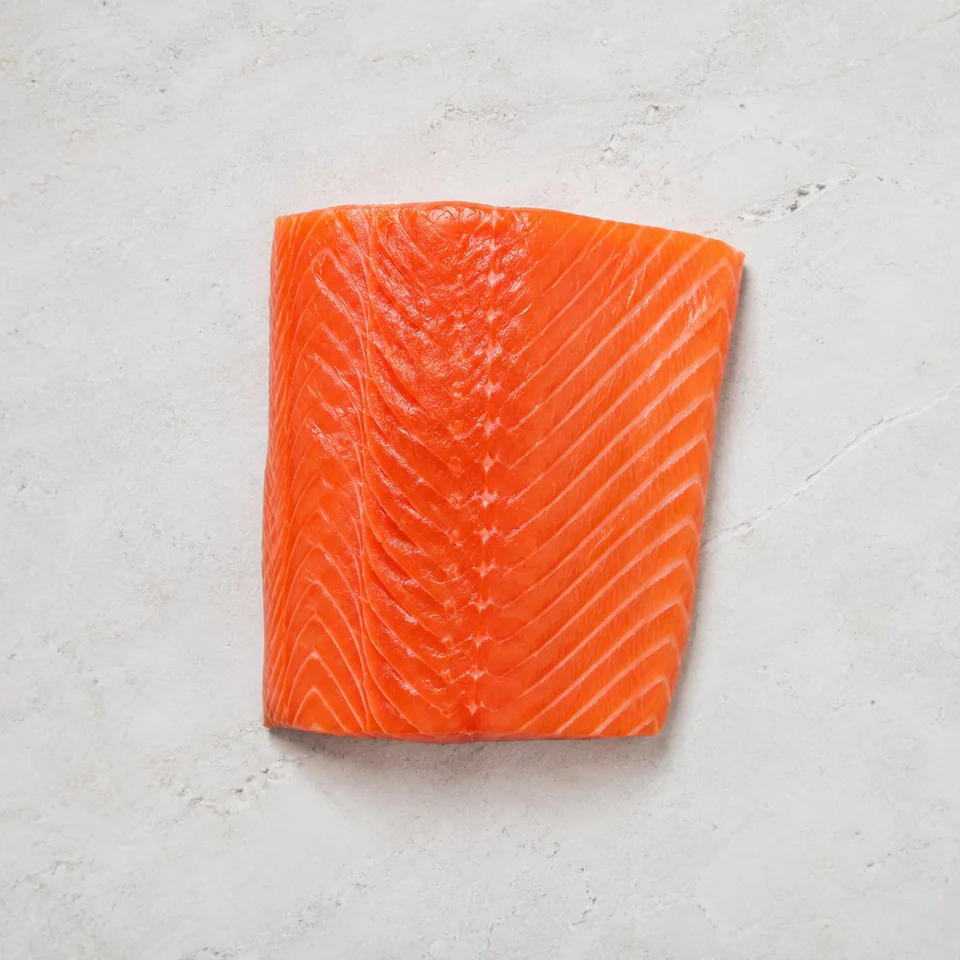
This record uses USDA data for raw, wild-caught sockeye salmon, rather than all salmon species or farming methods. Per 100 g of edible portion it provides about 130 kcal, 22.3 g protein, 4.94 g fat and 0.722 g saturated fat. The source reports 0 g carbohydrate by difference. The source also reports 0.211 g EPA and 0.326 g DHA per 100 g. These values do not describe smoked, cured or cooked salmon.
Pianifica la tua porzione
Quanto c'è nella tua porzione di Salmon?
Nutrition values are reported per 100 g of raw salmon. A typical 4 oz fillet (about 113 g) provides roughly 147 kcal. Use the serving sizes below to estimate portions when logging.
Calcolato dal riferimento per 100 g. I valori sono arrotondati.
Porzione
Peso
Calorie
Carboidrati
Proteine
Grassi
100 g
100 g
130 kcal
0 g
22.3 g
4.9 g
4 oz fillet
113 g
146.9 kcal
0 g
25.2 g
5.6 g
8 oz fillet
227 g
295.1 kcal
0 g
50.6 g
11.2 g
Usa il peso della parte edibile nello stato dell'alimento mostrato sopra.
Energia (kcal)
130 kcal
Energia (kJ)
543.9 kJ
Proteine
22.3 g
Carboidrati
0 g
Grassi
4.936 g
Fibra alimentare
0 g
Grassi saturi
0.722 g
Colesterolo
59.3 mg
Sodio
53.3 mg
Calcio
14.84 mg
Potassio
329.7 mg
Magnesio
26.15 mg
Ferro
0.4024 mg
Zinco
0.4246 mg
Vitamina B12
5.16 µg
Retinolo
42.81 µg
Domande e risposte
Salmon FAQ sulla nutrizione
How many calories are in salmon?
Salmon provides about 130 calories per 100 g. A typical 4 oz fillet (about 113 g) provides roughly 147 calories.
Is salmon high in protein?
Yes. Salmon provides about 22.3 g of protein per 100 g.
Is salmon high in omega-3?
The cited raw, wild-caught sockeye salmon record reports 0.211 g EPA and 0.326 g DHA per 100 g. These are omega-3 fatty acids.