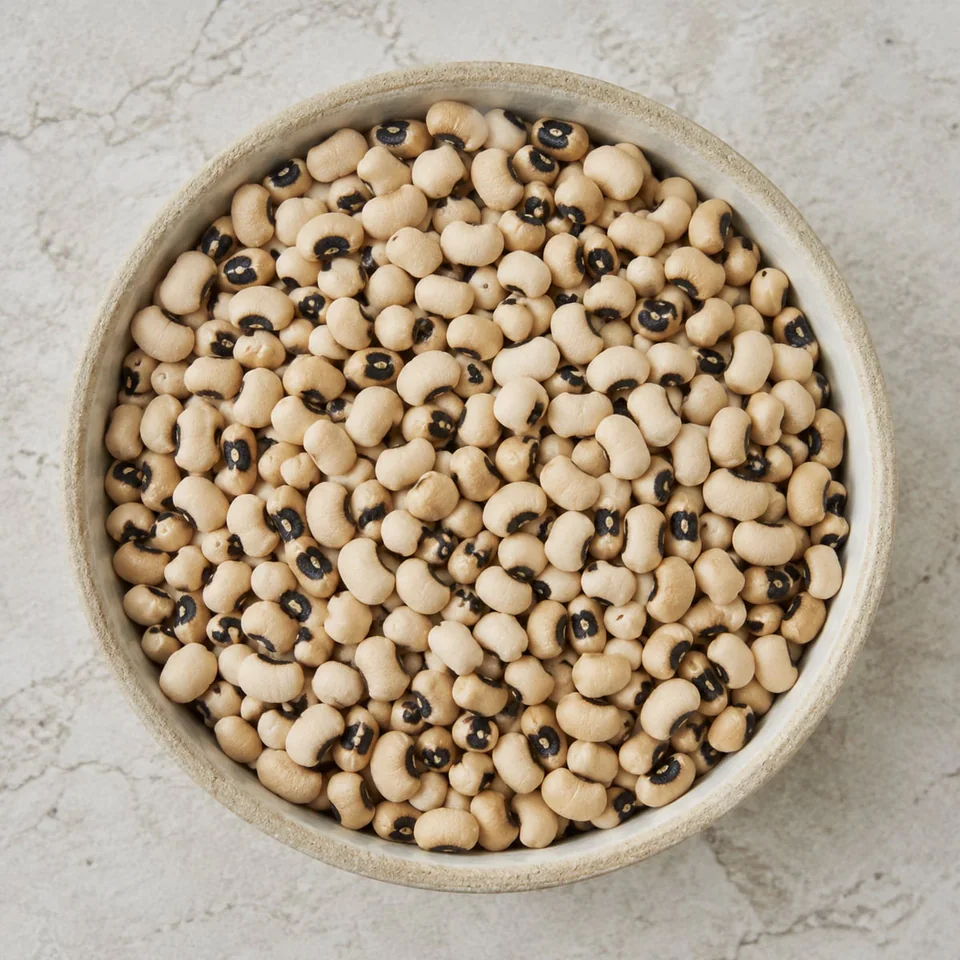
Black-eyed peas are small, cream-colored legumes with a distinctive black spot. They are a staple in Southern U.S. and African cooking and are used in stews, salads, and rice dishes.
Nutritionally, black-eyed peas are a source of plant protein and fiber. Per 100 g of canned black-eyed peas with sodium added, drained and rinsed they provide about 116 kcal, 19.2 g of carbohydrates, 6.9 g of protein, 1.3 g of fat, and 4.3 g of dietary fiber.
Black-eyed peas are commonly eaten cooked, either from dry or canned. Use the serving sizes below to estimate portions when logging.
Plan your portion
How much is in your serving of Black-eyed Peas (canned)?
Nutrition values apply to canned black-eyed peas with sodium added, drained and rinsed, per 100 g edible portion. A 171 g portion provides roughly 198 kcal using the existing energy value. The existing cup-to-weight estimate is unverified.
Calculated from the per-100-g reference. Values are rounded.
Serving
Weight
Calories
Carbs
Protein
Fat
100 g
100 g
116 kcal
19.2 g
6.9 g
1.3 g
1 cup cooked
171 g
198.4 kcal
32.8 g
11.8 g
2.2 g
1/2 cup cooked
86 g
99.8 kcal
16.5 g
6 g
1.1 g
Use the weight of the edible portion in the food state shown above.
Energy (kcal)
116 kcal
Energy (kJ)
485.5 kJ
Protein
6.92 g
Carbohydrates
19.1659 g
Fat
1.296 g
Dietary fiber
4.338 g
Sodium
226.7 mg
Calcium
27.78 mg
Potassium
138.1 mg
Magnesium
27.26 mg
Iron
1.084 mg
Zinc
0.655 mg
Questions and answers
Black-eyed Peas (canned) nutrition FAQ
How many calories are in black-eyed peas?
Canned black-eyed peas with sodium added, drained and rinsed, provide about 116 calories per 100 g according to the current record.
Are black-eyed peas high in protein?
Canned black-eyed peas with sodium added, drained and rinsed, provide 6.92 g of protein per 100 g.
Are black-eyed peas high in fiber?
Canned black-eyed peas with sodium added, drained and rinsed, provide 4.34 g of dietary fiber per 100 g.