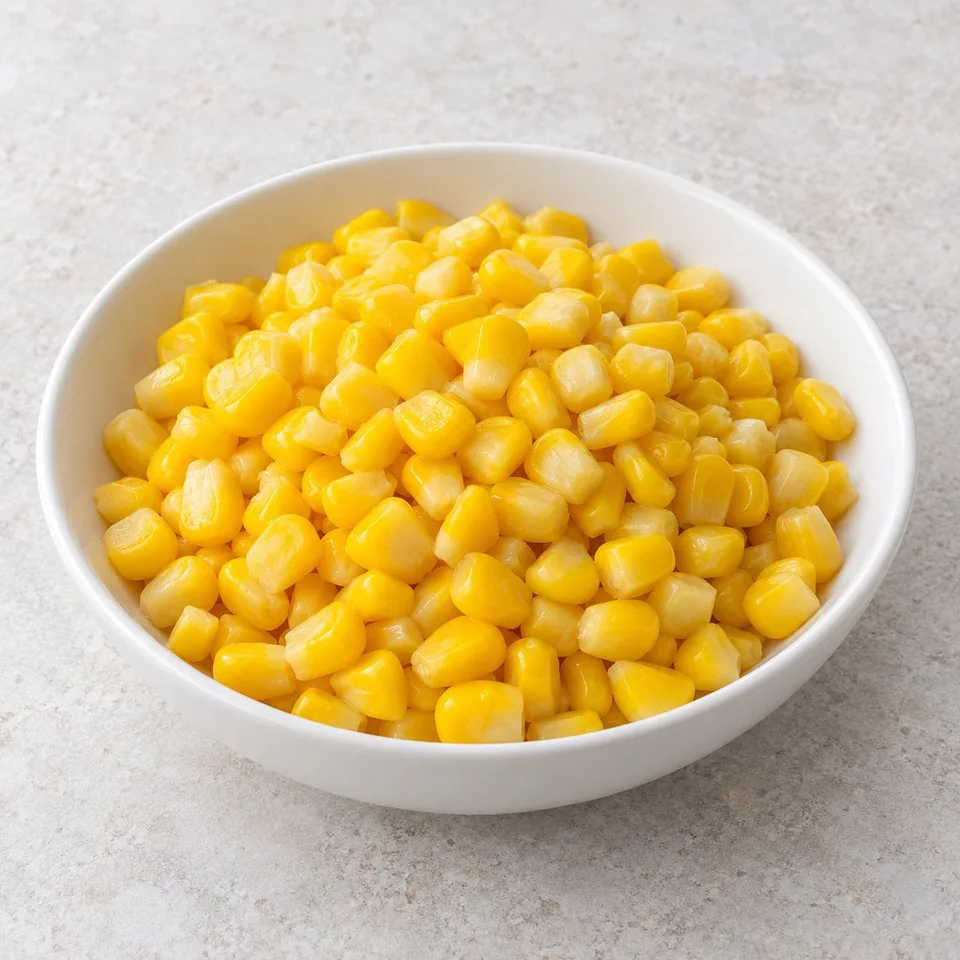
Corn is a starchy grain eaten as a vegetable, with sweet yellow kernels on a cob. Per 100 g it provides 86 calories with 18.6 g carbs and 3.3 g protein.
Corn, also called maize, is a starchy cereal grain whose sweet yellow kernels are eaten as a vegetable. It is enjoyed on the cob, cut into salads and salsas, or used in soups, and can be boiled, steamed, grilled, or roasted.
Nutritionally, corn is mainly carbohydrate. Per 100 g it provides about 86 kcal, 18.6 g of carbohydrates, 3.3 g of protein, and 1.4 g of fat, with 2 g of dietary fiber, 131 mg of sodium, and 2 mg of calcium. This reference reflects cooked sweet corn kernels.
Corn can be eaten as kernels or on the cob, and the edible portion is just the kernels. For accurate tracking, weigh the kernels (not the cob) or use the serving sizes below.
Plan your portion
How much is in your serving of Corn?
Nutrition values are reported per 100 g. A typical medium ear of corn (about 90 g of kernels) provides roughly 77 kcal. Use the serving sizes below to estimate portions when logging.
Calculated from the per-100-g reference. Values are rounded.
Serving
Weight
Calories
Carbs
Protein
Fat
100 g
100 g
86 kcal
18.6 g
3.3 g
1.4 g
1 medium ear
90 g
77.4 kcal
16.7 g
2.9 g
1.2 g
1/2 cup kernels
82 g
70.5 kcal
15.3 g
2.7 g
1.1 g
Use the weight of the edible portion in the food state shown above.
Energy (kcal)
86 kcal
Energy (kJ)
359.8 kJ
Protein
3.26 g
Carbohydrates
18.6 g
Fat
1.35 g
Dietary fiber
2 g
Sugars
6.24 g
Saturated fat
0.324 g
Cholesterol
0 mg
Sodium
131 mg
Calcium
2 mg
Potassium
269 mg
Magnesium
37 mg
Iron
0.52 mg
Zinc
0.46 mg
Vitamin B1
0.139 mg
Vitamin B2
0.052 mg
Vitamin B3
1.68 mg
Vitamin B6
0.083 mg
Vitamin B9 (folate)
36 µg
Vitamin B12
0 µg
Vitamin C
5.8 mg
Vitamin D
0 µg
Vitamin A (RAE)
9 µg
Retinol
0 µg
Beta-carotene
45 µg
Alpha-carotene
15 µg
Beta-cryptoxanthin
109 µg
Vitamin E (alpha-tocopherol)
0.07 mg
Vitamin K1 (phylloquinone)
0.3 µg
Questions and answers
Corn nutrition FAQ
How many calories are in corn?
Cooked corn provides about 86 calories per 100 g of kernels. A medium ear (about 90 g of kernels) provides roughly 77 calories.
Is corn a vegetable or a grain?
Corn is botanically a grain, but sweet corn is often eaten as a vegetable. It is mainly carbohydrate, providing about 18.6 g of carbs per 100 g.
How should I measure corn?
Weigh only the edible kernels, not the cob. Cut kernels can be measured by the cup or weighed directly for accurate tracking.