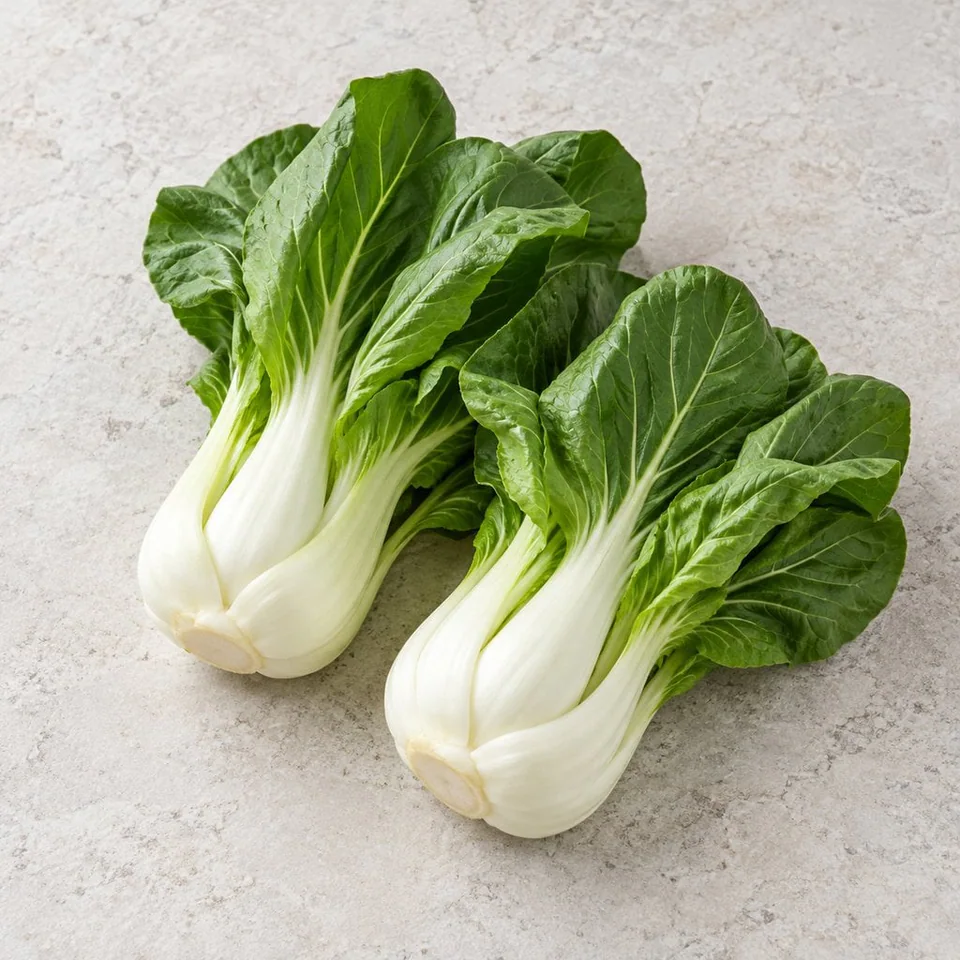
Bok choy is a mild Chinese cabbage with crisp white stalks and tender green leaves, eaten raw or cooked. Per 100 g it provides 13 calories with 2.2 g carbs and 1 g fiber.
Bok choy, also called pak choi, is a mild Chinese cabbage with crisp white stalks and tender green leaves. It is a staple in East Asian cooking, stir-fried, steamed, or simmered in soups, and can also be eaten raw.
Nutritionally, bok choy is very low in calories and mostly water. Per 100 g it provides about 13 kcal, 2.2 g of carbohydrates, 1.5 g of protein, and 0.2 g of fat, with 1 g of dietary fiber, 65 mg of sodium, and 105 mg of calcium.
Bok choy cooks down quickly and its stalks stay crisp. For accurate tracking, weigh it raw or cooked as prepared and use the serving sizes below.
Plan your portion
How much is in your serving of Bok Choy?
Nutrition values are reported per 100 g. A typical 1 cup of shredded bok choy (about 70 g) provides roughly 9 kcal. Use the serving sizes below to estimate portions when logging.
Calculated from the per-100-g reference. Values are rounded.
Serving
Weight
Calories
Carbs
Protein
Fat
100 g
100 g
13 kcal
2.2 g
1.5 g
0.2 g
1 cup shredded
70 g
9.1 kcal
1.5 g
1.1 g
0.1 g
1 cup cooked
170 g
22.1 kcal
3.7 g
2.6 g
0.3 g
Use the weight of the edible portion in the food state shown above.
Energy (kcal)
13 kcal
Energy (kJ)
54.4 kJ
Protein
1.5 g
Carbohydrates
2.18 g
Fat
0.2 g
Dietary fiber
1 g
Sugars
1.18 g
Saturated fat
0.027 g
Cholesterol
0 mg
Sodium
65 mg
Calcium
105 mg
Potassium
252 mg
Magnesium
19 mg
Iron
0.8 mg
Zinc
0.19 mg
Vitamin B1
0.04 mg
Vitamin B2
0.07 mg
Vitamin B3
0.5 mg
Vitamin B6
0.194 mg
Vitamin B9 (folate)
66 µg
Vitamin B12
0 µg
Vitamin C
45 mg
Vitamin D
0 µg
Vitamin A (RAE)
223 µg
Retinol
0 µg
Beta-carotene
2680 µg
Alpha-carotene
1 µg
Beta-cryptoxanthin
0 µg
Vitamin E (alpha-tocopherol)
0.09 mg
Vitamin K1 (phylloquinone)
45.5 µg
Questions and answers
Bok Choy nutrition FAQ
How many calories are in bok choy?
Bok choy provides about 13 calories per 100 g. A typical 1 cup of shredded bok choy (about 70 g) provides roughly 9 calories.
Is bok choy good for calcium?
Bok choy provides about 105 mg of calcium per 100 g, which is notable for a leafy green.
How is bok choy cooked?
Bok choy is often stir-fried, steamed, or simmered in soups. It cooks quickly, and the stalks stay crisp.