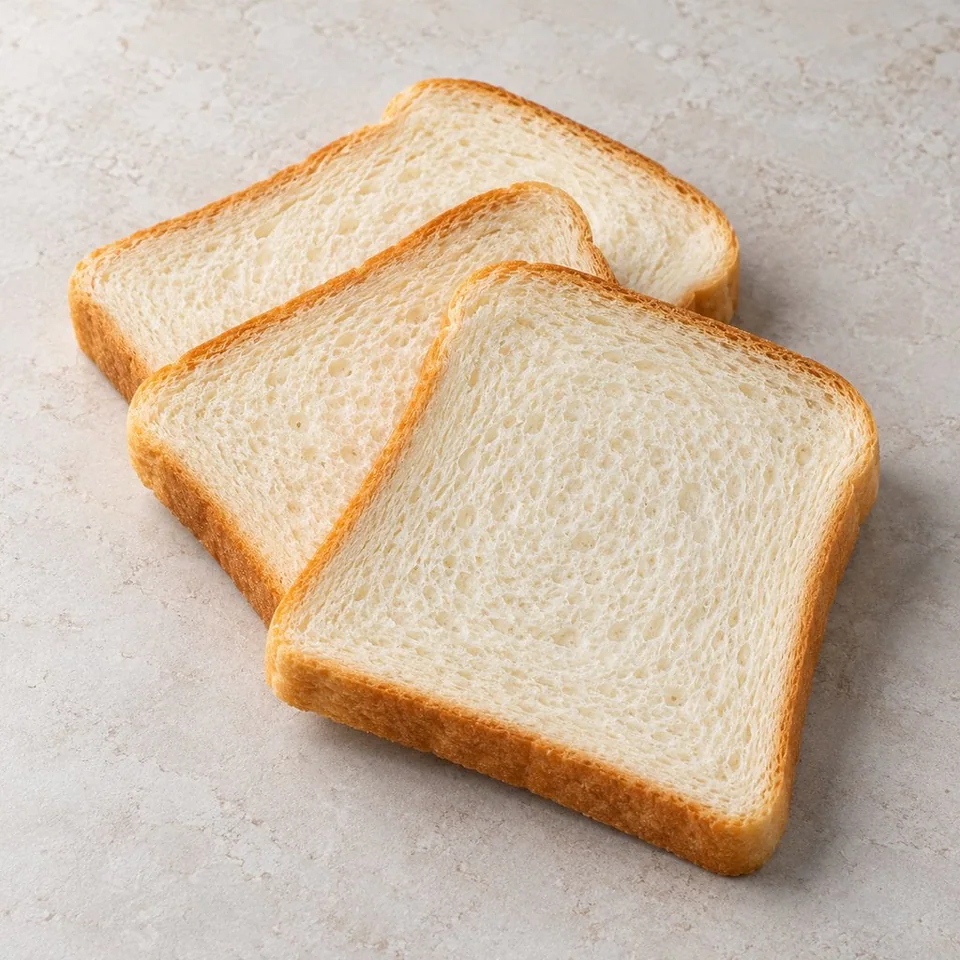
Bread is a staple baked food made from flour, water, and yeast or another leavening agent. Per 100 g it provides 267 calories with 49.2 g carbs and 9.4 g protein.
Bread is a baked staple made from flour, water, and a leavening agent such as yeast. It is eaten as toast, in sandwiches, or as an accompaniment to meals. Loaves vary widely in flour type, texture, and added ingredients.
Nutritionally, bread is primarily a source of carbohydrate. Per 100 g it provides about 267 kcal, 49.2 g of carbohydrates, 9.4 g of protein, and 3.6 g of fat, with 2.3 g of dietary fiber, 450 mg of sodium, and 211 mg of calcium.
A single slice typically weighs about 25 to 40 g depending on loaf size and thickness, so per-slice nutrition is well below the per-100 g values. For accurate tracking, weigh slices or check the serving sizes below.
Plan your portion
How much is in your serving of Bread?
Nutrition values are reported per 100 g. A typical slice (about 28 g) provides roughly 75 kcal. Use the serving sizes below to estimate portions when logging.
Calculated from the per-100-g reference. Values are rounded.
Serving
Weight
Calories
Carbs
Protein
Fat
100 g
100 g
267 kcal
49.2 g
9.4 g
3.6 g
1 slice
28 g
74.8 kcal
13.8 g
2.6 g
1 g
2 slices
56 g
149.5 kcal
27.6 g
5.3 g
2 g
Use the weight of the edible portion in the food state shown above.
Energy (kcal)
267 kcal
Energy (kJ)
1117.1 kJ
Protein
9.43 g
Carbohydrates
49.2 g
Fat
3.59 g
Dietary fiber
2.3 g
Sugars
5.34 g
Saturated fat
0.821 g
Cholesterol
0 mg
Sodium
450 mg
Calcium
211 mg
Potassium
117 mg
Magnesium
27 mg
Iron
3.36 mg
Zinc
0.88 mg
Vitamin B1
0.507 mg
Vitamin B2
0.24 mg
Vitamin B3
4.76 mg
Vitamin B6
0.092 mg
Vitamin B9 (folate)
111 µg
Vitamin B12
0 µg
Vitamin C
0 mg
Vitamin D
0 µg
Vitamin A (RAE)
0 µg
Retinol
0 µg
Beta-carotene
0 µg
Alpha-carotene
0 µg
Beta-cryptoxanthin
0 µg
Vitamin E (alpha-tocopherol)
0.22 mg
Vitamin K1 (phylloquinone)
0.2 µg
Questions and answers
Bread nutrition FAQ
How many calories are in a slice of bread?
A typical slice of bread (about 28 g) provides roughly 75 calories. Per 100 g, bread provides about 267 calories.
Is bread high in carbs?
Yes. Bread provides about 49.2 g of carbohydrates per 100 g, making it a significant source of carbohydrate. A typical slice (about 28 g) has roughly 14 g of carbs.
How much does a slice of bread weigh?
A slice of bread typically weighs about 25 to 40 g depending on loaf size and thickness. Weighing slices is the most accurate way to track them.