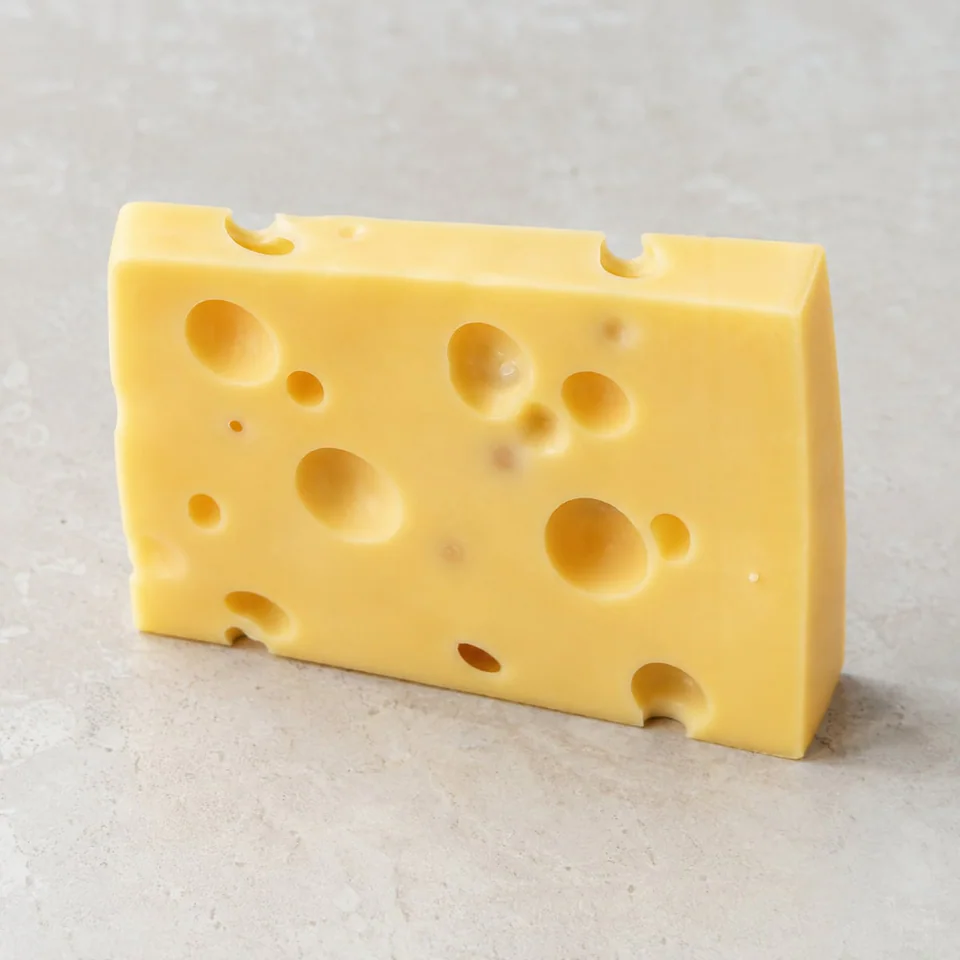
Swiss cheese is a firm, pale-yellow cheese with a mild, slightly nutty flavor and distinctive holes formed during aging. It is eaten on its own, in sandwiches, and melted in dishes.
Nutritionally, swiss cheese is high in protein, fat, and calcium. Per 100 g it provides about 393 kcal, 1.4 g of carbohydrates, 27 g of protein, and 31 g of fat, with 185 mg of sodium and 890 mg of calcium.
Swiss cheese is calorie-dense, so small portions add many calories. For accurate tracking, weigh or slice the cheese, and use the serving sizes below.
Planifiez votre portion
Quelle quantité contient votre portion de Swiss Cheese?
Nutrition values are reported per 100 g. A typical 1 oz serving (about 28 g) provides roughly 110 kcal. Use the serving sizes below to estimate portions when logging.
Calculé à partir de la référence par 100 g. Les valeurs sont arrondies.
Portion
Poids
Calories
Glucides
Protéines
Graisse
100 g
100 g
393 kcal
1.4 g
27 g
31 g
1 oz
28 g
110 kcal
0.4 g
7.6 g
8.7 g
1 slice
21 g
82.5 kcal
0.3 g
5.7 g
6.5 g
Utilisez le poids de la partie comestible dans l'état de l'aliment indiqué ci-dessus.
Énergie (kcal)
393 kcal
Énergie (kJ)
1640 kJ
Protéines
27 g
Glucides
1.44 g
Graisse
31 g
Fibres alimentaires
0 g
Sucres
0 g
Acides gras saturés
18.2 g
Gras trans
0.993 g
Cholestérol
93 mg
Sodium
185 mg
Calcium
890 mg
Potassium
71 mg
Magnésium
33.4 mg
Fer
0.13 mg
Zinc
4.37 mg
Vitamine B1
0.011 mg
Vitamine B2
0.303 mg
Vitamine B3
0.06 mg
Vitamine B5
0.352 mg
Vitamine B6
0.07 mg
Vitamine B9 (folate)
9 µg
Vitamine B12
3.02 µg
Vitamine D
0 µg
Vitamine A (RAE)
292 µg
Rétinol
287 µg
Bêta-carotène
60 µg
Alpha-carotène
1 µg
Bêta-cryptoxanthine
2 µg
Vitamine E (alpha-tocophérol)
0.6 mg
Vitamine K1 (phylloquinone)
1.4 µg
Vitamine K2 (MK-4)
6.3 µg
Questions et réponses
Swiss Cheese FAQ nutrition
How many calories are in swiss cheese?
Swiss cheese provides about 393 calories per 100 g. A typical 1 oz serving (about 28 g) provides roughly 110 calories.
Is swiss cheese high in calcium?
Yes. Swiss cheese provides about 890 mg of calcium per 100 g.
Is swiss cheese high in protein?
Yes. Swiss cheese provides about 27 g of protein per 100 g, along with 31 g of fat.