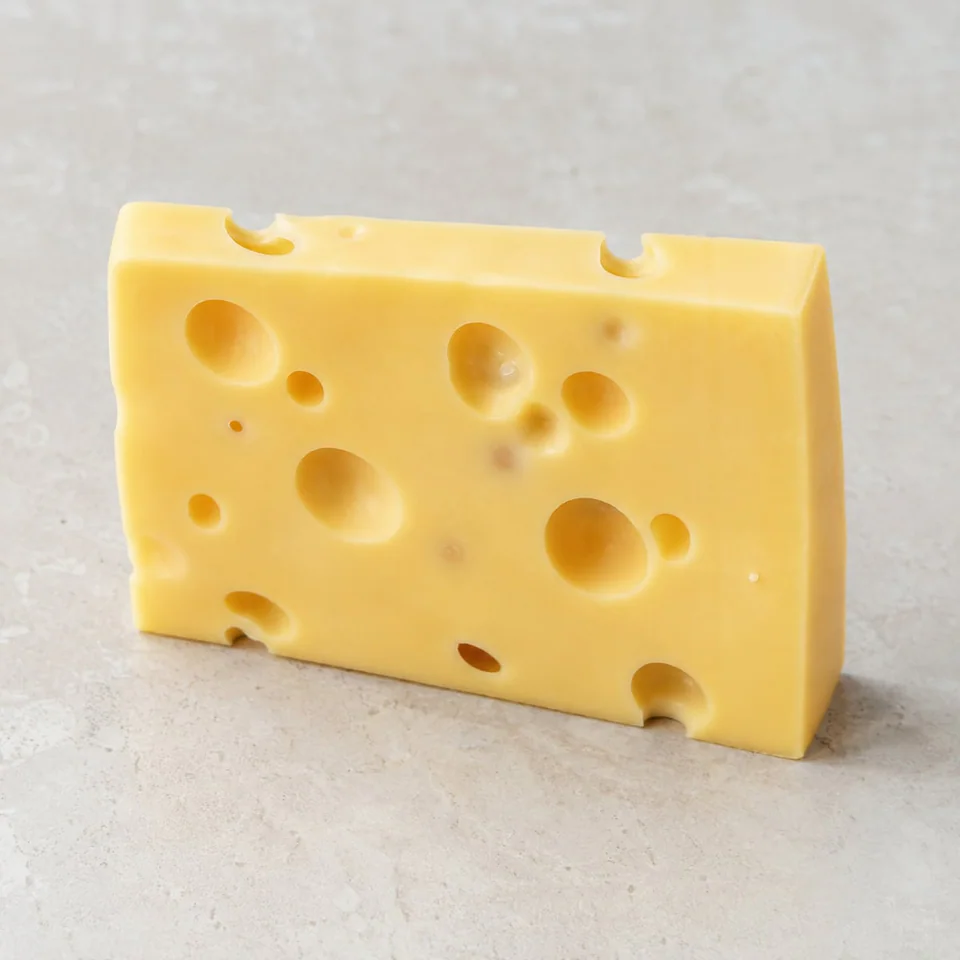
Swiss cheese is a firm, pale-yellow cheese with a mild, slightly nutty flavor and distinctive holes formed during aging. It is eaten on its own, in sandwiches, and melted in dishes.
Nutritionally, swiss cheese is high in protein, fat, and calcium. Per 100 g it provides about 393 kcal, 1.4 g of carbohydrates, 27 g of protein, and 31 g of fat, with 185 mg of sodium and 890 mg of calcium.
Swiss cheese is calorie-dense, so small portions add many calories. For accurate tracking, weigh or slice the cheese, and use the serving sizes below.
Plan your portion
How much is in your serving of Swiss Cheese?
Nutrition values are reported per 100 g. A typical 1 oz serving (about 28 g) provides roughly 110 kcal. Use the serving sizes below to estimate portions when logging.
Calculated from the per-100-g reference. Values are rounded.
Serving
Weight
Calories
Carbs
Protein
Fat
100 g
100 g
393 kcal
1.4 g
27 g
31 g
1 oz
28 g
110 kcal
0.4 g
7.6 g
8.7 g
1 slice
21 g
82.5 kcal
0.3 g
5.7 g
6.5 g
Use the weight of the edible portion in the food state shown above.
Energy (kcal)
393 kcal
Energy (kJ)
1640 kJ
Protein
27 g
Carbohydrates
1.44 g
Fat
31 g
Dietary fiber
0 g
Sugars
0 g
Saturated fat
18.2 g
Trans fat
0.993 g
Cholesterol
93 mg
Sodium
185 mg
Calcium
890 mg
Potassium
71 mg
Magnesium
33.4 mg
Iron
0.13 mg
Zinc
4.37 mg
Vitamin B1
0.011 mg
Vitamin B2
0.303 mg
Vitamin B3
0.06 mg
Vitamin B5
0.352 mg
Vitamin B6
0.07 mg
Vitamin B9 (folate)
9 µg
Vitamin B12
3.02 µg
Vitamin D
0 µg
Vitamin A (RAE)
292 µg
Retinol
287 µg
Beta-carotene
60 µg
Alpha-carotene
1 µg
Beta-cryptoxanthin
2 µg
Vitamin E (alpha-tocopherol)
0.6 mg
Vitamin K1 (phylloquinone)
1.4 µg
Vitamin K2 (MK-4)
6.3 µg
Questions and answers
Swiss Cheese nutrition FAQ
How many calories are in swiss cheese?
Swiss cheese provides about 393 calories per 100 g. A typical 1 oz serving (about 28 g) provides roughly 110 calories.
Is swiss cheese high in calcium?
Yes. Swiss cheese provides about 890 mg of calcium per 100 g.
Is swiss cheese high in protein?
Yes. Swiss cheese provides about 27 g of protein per 100 g, along with 31 g of fat.