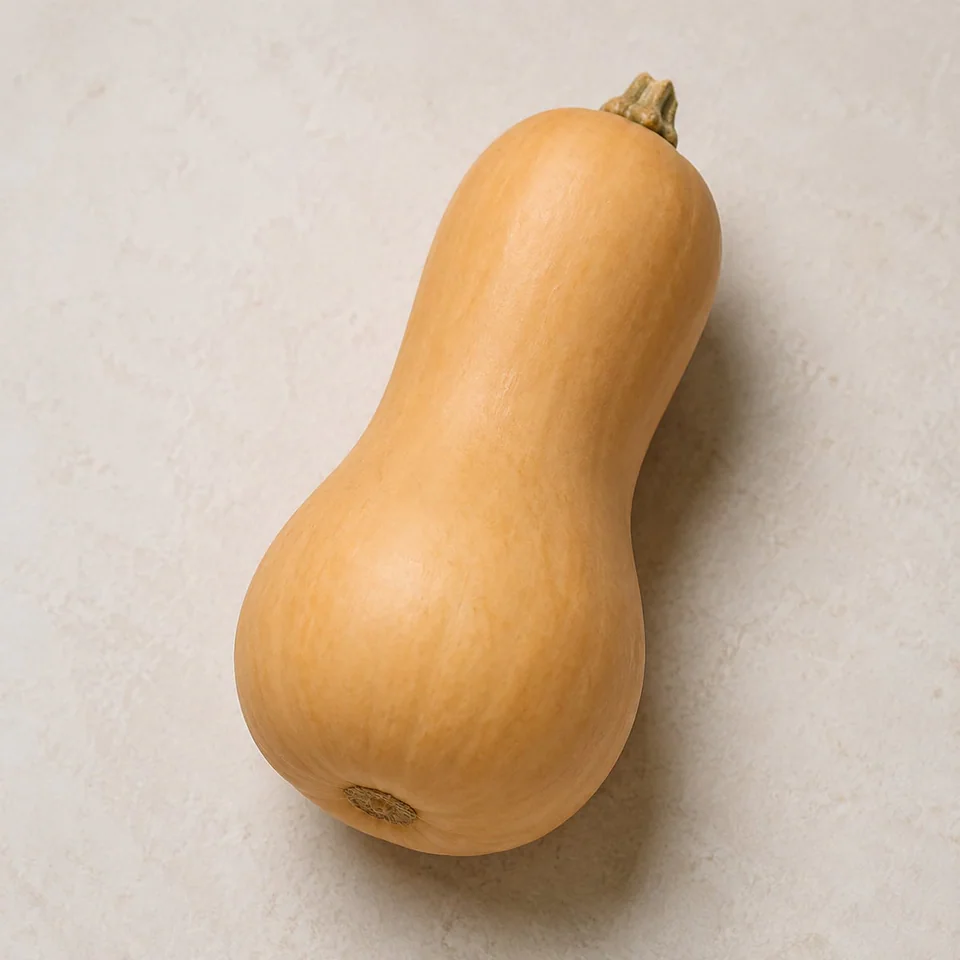
Butternut SquashNutrition reference
Vegetables

Butternut Squash

Butternut squash is a sweet, orange winter squash, usually roasted or pureed. Per 100 g it provides about 48 calories with 10.5 g carbs.

48.1
kcalper 100g
Carbs
10.51g
Protein
1.15g
Fat
0.17g
Browse all foods

Nutrition facts

Per 100 grams

Reference values
Measurement basis
Food state
Raw
Edible portion
Raw butternut squash flesh
Measurement basis
Per 100 g raw edible portion
Energy (kcal)
48.1 kcal
Protein1
1.14875 g
Carbohydrates1
10.5075 g
Fat1
0.1675 g
Dietary fiber1
1.959 g
Sugars
2.2 g
Saturated fat
0.021 g
Sodium41
<2.5 mg
More nutrients25
Energy (kJ)
201.4 kJ
Added sugars23
0 g
Trans fat2
0 g
Cholesterol2
0 mg
Calcium1
21.74 mg
Potassium1
329.1 mg
Magnesium1
14.95 mg
Iron1
0.2129 mg
Zinc1
0.193 mg
Vitamin B1
0.1 mg
Vitamin B2
0.02 mg
Vitamin B3
1.2 mg
Vitamin B5
0.4 mg
Vitamin B6
0.154 mg
Vitamin B9 (folate)1
55 µg
Vitamin B122
0 µg
Vitamin C1
7.6 mg
Vitamin D2
0 µg
Vitamin A (RAE)
532 µg
Retinol2
0 µg
Beta-carotene
4226 µg
Alpha-carotene
834 µg
Beta-cryptoxanthin
3471 µg
Vitamin E (alpha-tocopherol)
1.44 mg
Vitamin K1 (phylloquinone)
1.1 µg
  1. Assumed zero by source
  2. Additional data source[3]
  1. Additional data source[1]
  2. Below quantification limit

Data sources

4
  1. 1

    USDA FoodData Central, Foundation Foods

    2685570 · Foundation Foods April 2026; 2024-04-18

  2. 2

    U.S. Department of Agriculture, Agricultural Research Service

    169295 · SR Legacy April 2018; 2019-04-01

  3. 3

    Norwegian Food Safety Authority

    06.210 · Norwegian Food Composition Table2026, January2026

  4. 4

    Food Standards Australia New Zealand

    F007535 · Australian Food Composition Database Release3, December2025

About this food

Understanding this nutrition reference

Butternut squash is a winter squash with tan skin and sweet, orange flesh. It is usually roasted, boiled, or pureed into soups and is a popular fall vegetable.

Nutritionally, butternut squash is mostly carbohydrate. Per 100 g of raw squash provides about 48 kcal, 10.5 g of carbohydrates, 1.1 g of protein, 0.2 g of fat, and 2.0 g of dietary fiber.

Butternut squash is usually cooked before eating. Use the serving sizes below to estimate portions when logging.

Plan your portion

How much is in your serving of Butternut Squash?

Nutrition values are reported per 100 g. A typical cup of cubed squash (about 140 g) provides roughly 67 kcal. Use the serving sizes below to estimate portions when logging.

Calculated from the per-100-g reference. Values are rounded.
ServingWeightCaloriesCarbsProteinFat
100 g100 g48.1 kcal10.5 g1.1 g0.2 g
1 cup cubed140 g67.3 kcal14.7 g1.6 g0.2 g
1/2 cup cubed70 g33.7 kcal7.4 g0.8 g0.1 g

Use the weight of the edible portion in the food state shown above.

Energy (kcal)
48.1 kcal
Energy (kJ)
201.4 kJ
Protein1
1.14875 g
Carbohydrates1
10.5075 g
Fat1
0.1675 g
Dietary fiber1
1.959 g
Sugars
2.2 g
Added sugars23
0 g
Saturated fat
0.021 g
Trans fat2
0 g
Cholesterol2
0 mg
Sodium41
<2.5 mg
Calcium1
21.74 mg
Potassium1
329.1 mg
Magnesium1
14.95 mg
Iron1
0.2129 mg
Zinc1
0.193 mg
Vitamin B1
0.1 mg
Vitamin B2
0.02 mg
Vitamin B3
1.2 mg
Vitamin B5
0.4 mg
Vitamin B6
0.154 mg
Vitamin B9 (folate)1
55 µg
Vitamin B122
0 µg
Vitamin C1
7.6 mg
Vitamin D2
0 µg
Vitamin A (RAE)
532 µg
Retinol2
0 µg
Beta-carotene
4226 µg
Alpha-carotene
834 µg
Beta-cryptoxanthin
3471 µg
Vitamin E (alpha-tocopherol)
1.44 mg
Vitamin K1 (phylloquinone)
1.1 µg

Questions and answers

Butternut Squash nutrition FAQ

How many calories are in butternut squash?

Butternut squash provides about 48 calories per 100 g.

Is butternut squash high in carbs?

Butternut squash provides about 10.5 g of carbohydrates per 100 g.

Is butternut squash low in fat?

Yes. Butternut squash provides only about 0.2 g of fat per 100 g.