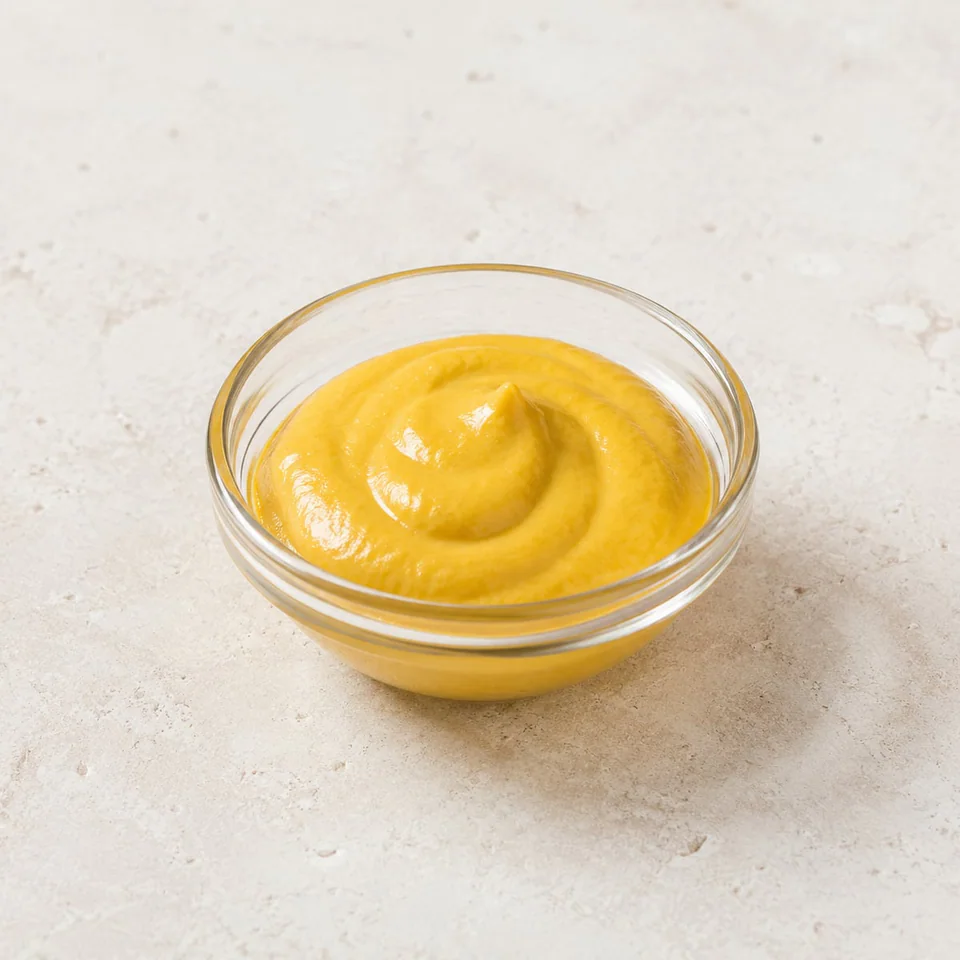
Mustard is a tangy condiment made from ground mustard seeds, vinegar, and seasonings. It is used on sandwiches, burgers, and hot dogs, and as an ingredient in dressings and sauces.
Nutritionally, mustard is low in calories and mostly water with a small amount of seed protein. Per 100 g it provides about 61 kcal, 5.3 g of carbohydrates, 4.3 g of protein, and 3.4 g of fat, with 4.3 g of dietary fiber, 1100 mg of sodium, and 63 mg of calcium.
Mustard is used in small amounts, though its sodium can be high. For accurate tracking, measure by the spoonful, and use the serving sizes below.
Plan your portion
How much is in your serving of Mustard?
Nutrition values are reported per 100 g. A typical 1 tsp serving (about 5 g) provides roughly 3 kcal. Use the serving sizes below to estimate portions when logging.
Calculated from the per-100-g reference. Values are rounded.
Serving
Weight
Calories
Carbs
Protein
Fat
100 g
100 g
61 kcal
5.3 g
4.3 g
3.4 g
1 tsp
5 g
3.1 kcal
0.3 g
0.2 g
0.2 g
1 tbsp
15 g
9.2 kcal
0.8 g
0.6 g
0.5 g
Use the weight of the edible portion in the food state shown above.
Energy (kcal)
61 kcal
Energy (kJ)
254 kJ
Protein
4.25 g
Carbohydrates
5.3 g
Fat
3.38 g
Dietary fiber
4.3 g
Sugars
1.42 g
Saturated fat
0.252 g
Trans fat
0.01 g
Sodium
1100 mg
Calcium
63 mg
Potassium
150 mg
Magnesium
47.7 mg
Iron
1.59 mg
Zinc
0.64 mg
Vitamin B1
0.189 mg
Vitamin B2
0.066 mg
Vitamin B3
0.561 mg
Vitamin B5
0.263 mg
Vitamin B6
0.069 mg
Vitamin B9 (folate)
7 µg
Vitamin C
0.4 mg
Vitamin A (RAE)
4 µg
Beta-carotene
31 µg
Alpha-carotene
1 µg
Beta-cryptoxanthin
27 µg
Vitamin E (alpha-tocopherol)
0.35 mg
Vitamin K1 (phylloquinone)
1.5 µg
Questions and answers
Mustard nutrition FAQ
How many calories are in mustard?
Mustard provides about 61 calories per 100 g. A typical 1 tsp serving (about 5 g) provides roughly 3 calories.
Is mustard low in calories?
Yes. Mustard is low in calories, providing about 61 calories per 100 g.
Is mustard high in sodium?
Mustard can be high in sodium, providing about 1100 mg per 100 g.