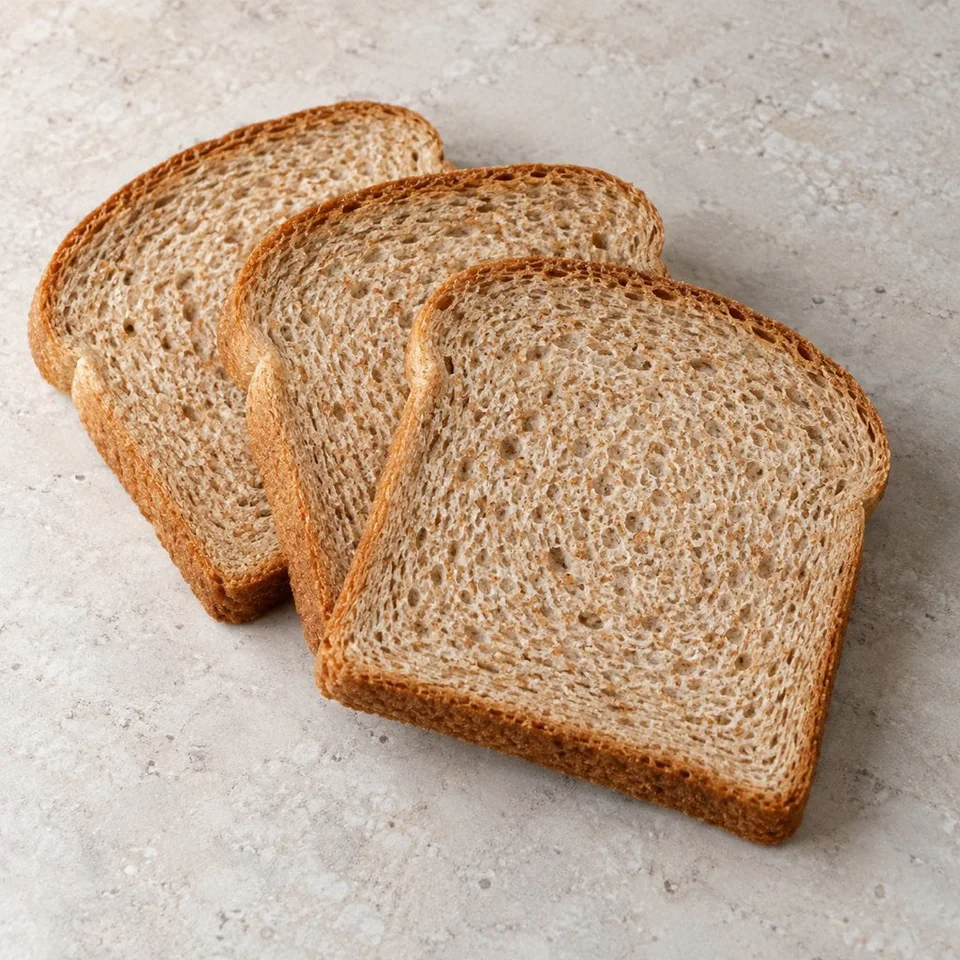
Whole wheat bread is made from flour that keeps the wheat bran and germ, giving it a denser texture and nuttier flavor. Per 100 g it provides 254 calories with 43.1 g carbs and 12.3 g protein.
Whole wheat bread is baked from flour that retains the wheat kernel's bran and germ, which gives it a denser texture, darker color, and nuttier flavor than white bread. It is eaten as toast, in sandwiches, or alongside meals.
Nutritionally, whole wheat bread is mainly carbohydrate with a notable amount of protein and fiber. Per 100 g it provides about 254 kcal, 43.1 g of carbohydrates, 12.3 g of protein, and 3.6 g of fat, with 6 g of dietary fiber, 430 mg of sodium, and 163 mg of calcium.
A single slice usually weighs about 25 to 40 g, so per-slice nutrition is well below the per-100 g values. For accurate tracking, weigh slices or use the serving sizes below.
Plan your portion
How much is in your serving of Whole Wheat Bread?
Nutrition values are reported per 100 g. A typical slice (about 32 g) provides roughly 81 kcal. Use the serving sizes below to estimate portions when logging.
Calculated from the per-100-g reference. Values are rounded.
Serving
Weight
Calories
Carbs
Protein
Fat
100 g
100 g
254 kcal
43.1 g
12.3 g
3.6 g
1 slice
32 g
81.3 kcal
13.8 g
3.9 g
1.2 g
2 slices
64 g
162.6 kcal
27.6 g
7.9 g
2.3 g
Use the weight of the edible portion in the food state shown above.
Energy (kcal)
254 kcal
Energy (kJ)
1062.7 kJ
Protein
12.3 g
Carbohydrates
43.1 g
Fat
3.6 g
Dietary fiber
6 g
Sugars
4.34 g
Saturated fat
0.722 g
Trans fat
0.02 g
Cholesterol
0 mg
Sodium
430 mg
Calcium
163 mg
Potassium
254 mg
Magnesium
75 mg
Iron
2.47 mg
Zinc
1.77 mg
Vitamin B1
0.394 mg
Vitamin B2
0.167 mg
Vitamin B3
4.438 mg
Vitamin B5
0.646 mg
Vitamin B6
0.215 mg
Vitamin B9 (folate)
42 µg
Vitamin B12
0 µg
Vitamin C
0 mg
Vitamin D
0 µg
Vitamin A (RAE)
0 µg
Retinol
0 µg
Beta-carotene
2 µg
Alpha-carotene
0 µg
Beta-cryptoxanthin
0 µg
Vitamin E (alpha-tocopherol)
2.66 mg
Vitamin K1 (phylloquinone)
7.8 µg
Questions and answers
Whole Wheat Bread nutrition FAQ
How many calories are in whole wheat bread?
Whole wheat bread provides about 254 calories per 100 g. A typical slice (about 32 g) provides roughly 81 calories.
Is whole wheat bread high in fiber?
Whole wheat bread provides about 6 g of dietary fiber per 100 g, more than white bread, because it keeps the wheat bran. A slice (about 32 g) has roughly 1.9 g of fiber.
How is whole wheat bread different from white bread?
Whole wheat bread keeps the wheat bran and germ, giving it more fiber and a denser texture than white bread. Their calories per 100 g are broadly similar.