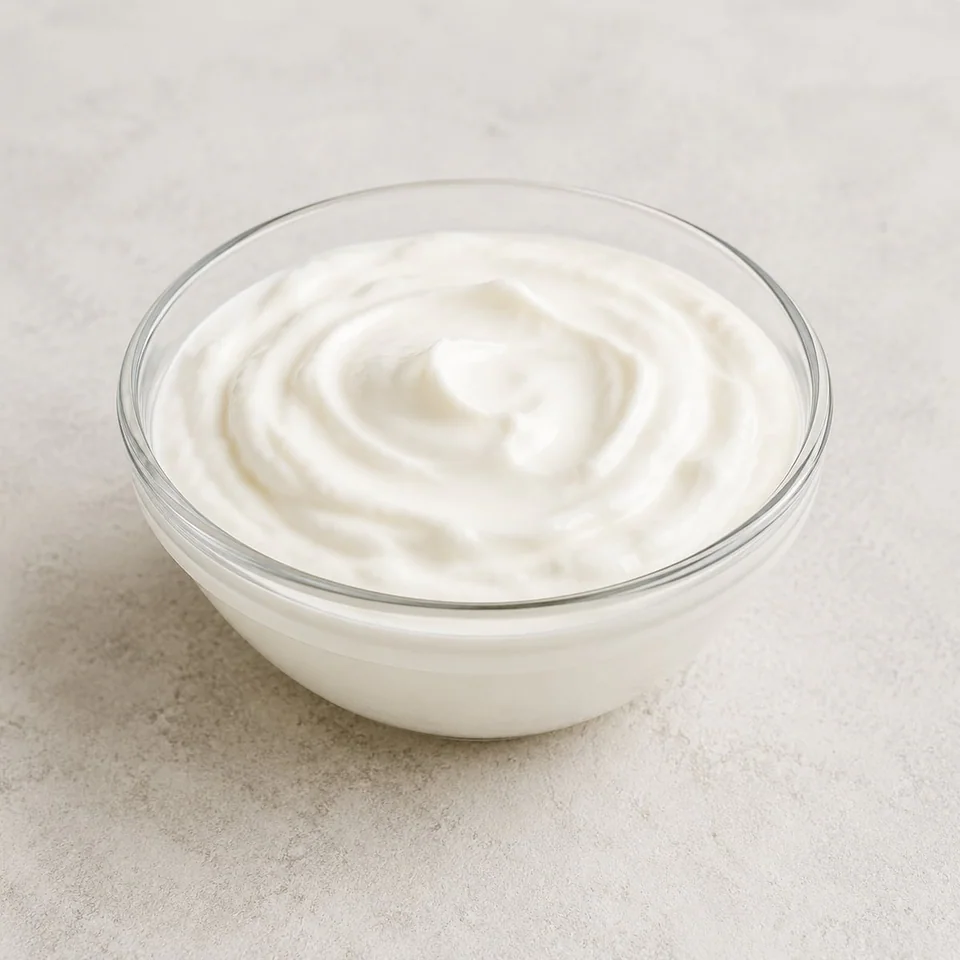
Greek yogurt is a thick, creamy yogurt made by straining regular yogurt to remove much of the liquid whey. It has a tangy flavor and a dense texture.
Nutritionally, Greek yogurt is a good source of protein. Per 100 g it provides about 94 kcal, 4.8 g of carbohydrates, 8.8 g of protein, and 4.4 g of fat. It also provides about 111 mg of calcium per 100 g.
Greek yogurt is eaten on its own or used in dips, sauces, and baking. Use the serving sizes below to estimate portions when logging.
Pianifica la tua porzione
Quanto c'è nella tua porzione di Greek Yogurt?
Nutrition values are reported per 100 g. A typical 170 g container provides roughly 159 kcal. Use the serving sizes below to estimate portions when logging.
Calcolato dal riferimento per 100 g. I valori sono arrotondati.
Porzione
Peso
Calorie
Carboidrati
Proteine
Grassi
100 g
100 g
93.7 kcal
4.8 g
8.8 g
4.4 g
1 container
170 g
159.3 kcal
8.1 g
14.9 g
7.5 g
1/2 cup
123 g
115.3 kcal
5.8 g
10.8 g
5.4 g
Usa il peso della parte edibile nello stato dell'alimento mostrato sopra.
Energia (kcal)
93.7 kcal
Energia (kJ)
391.9 kJ
Proteine
8.78 g
Carboidrati
4.75 g
Grassi
4.39 g
Fibra alimentare
0 g
Zuccheri
3.25 g
Grassi saturi
2.39 g
Colesterolo
16.8 mg
Sodio
33.8 mg
Calcio
110.9 mg
Potassio
147 mg
Magnesio
10.7 mg
Ferro
0 mg
Zinco
0.473 mg
Vitamina B1
0.055 mg
Vitamina B2
0.244 mg
Vitamina B3
0.227 mg
Vitamina B6
0.044 mg
Vitamina B7
0 µg
Vitamina D
0 µg
Retinolo
38.1 µg
Vitamina K1 (fillochinone)
0.2 µg
Vitamina K2 (MK-4)
1 µg
Domande e risposte
Greek Yogurt FAQ sulla nutrizione
How many calories are in greek yogurt?
Greek yogurt provides about 94 calories per 100 g. A typical 170 g container provides roughly 159 calories.
Is greek yogurt high in protein?
Yes. Greek yogurt provides about 8.8 g of protein per 100 g.
Is greek yogurt a good source of calcium?
Greek yogurt provides about 111 mg of calcium per 100 g.