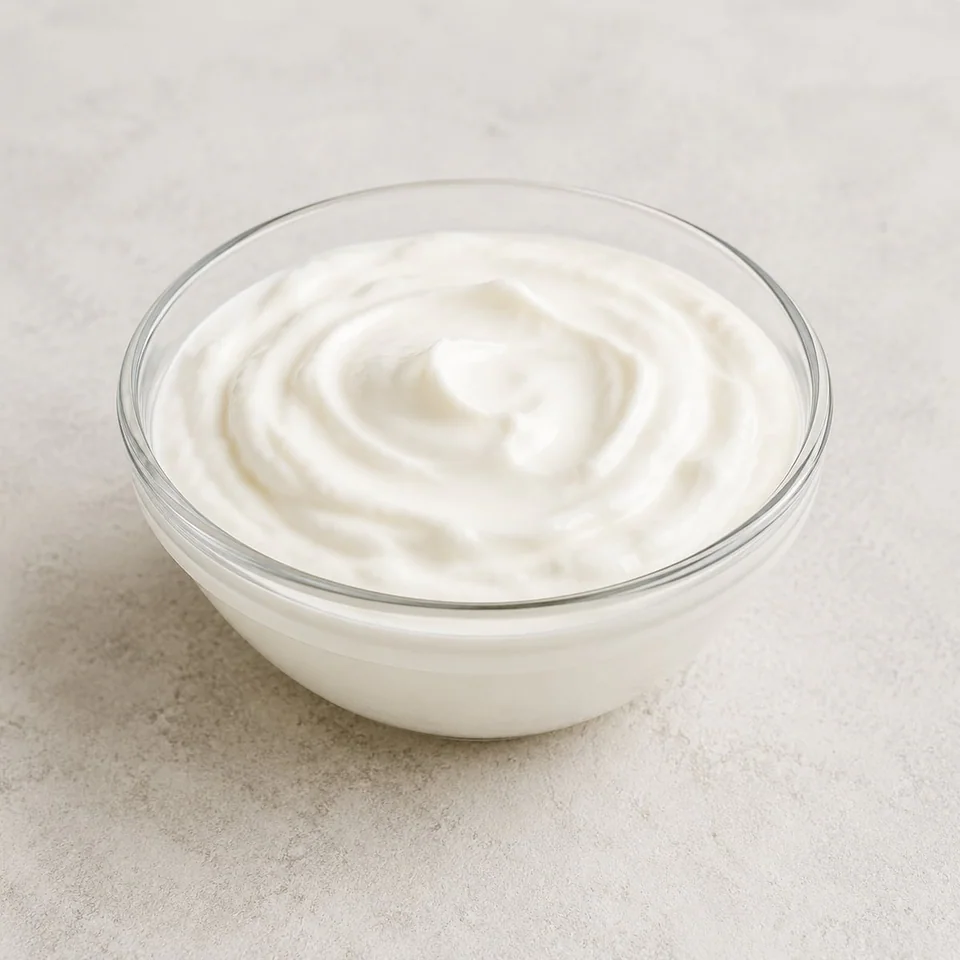
Greek yogurt is a thick, creamy yogurt made by straining regular yogurt to remove much of the liquid whey. It has a tangy flavor and a dense texture.
Nutritionally, Greek yogurt is a good source of protein. Per 100 g it provides about 94 kcal, 4.8 g of carbohydrates, 8.8 g of protein, and 4.4 g of fat. It also provides about 111 mg of calcium per 100 g.
Greek yogurt is eaten on its own or used in dips, sauces, and baking. Use the serving sizes below to estimate portions when logging.
Plan your portion
How much is in your serving of Greek Yogurt?
Nutrition values are reported per 100 g. A typical 170 g container provides roughly 159 kcal. Use the serving sizes below to estimate portions when logging.
Calculated from the per-100-g reference. Values are rounded.
Serving
Weight
Calories
Carbs
Protein
Fat
100 g
100 g
93.7 kcal
4.8 g
8.8 g
4.4 g
1 container
170 g
159.3 kcal
8.1 g
14.9 g
7.5 g
1/2 cup
123 g
115.3 kcal
5.8 g
10.8 g
5.4 g
Use the weight of the edible portion in the food state shown above.
Energy (kcal)
93.7 kcal
Energy (kJ)
391.9 kJ
Protein
8.78 g
Carbohydrates
4.75 g
Fat
4.39 g
Dietary fiber
0 g
Sugars
3.25 g
Saturated fat
2.39 g
Cholesterol
16.8 mg
Sodium
33.8 mg
Calcium
110.9 mg
Potassium
147 mg
Magnesium
10.7 mg
Iron
0 mg
Zinc
0.473 mg
Vitamin B1
0.055 mg
Vitamin B2
0.244 mg
Vitamin B3
0.227 mg
Vitamin B6
0.044 mg
Vitamin B7
0 µg
Vitamin D
0 µg
Retinol
38.1 µg
Vitamin K1 (phylloquinone)
0.2 µg
Vitamin K2 (MK-4)
1 µg
Questions and answers
Greek Yogurt nutrition FAQ
How many calories are in greek yogurt?
Greek yogurt provides about 94 calories per 100 g. A typical 170 g container provides roughly 159 calories.
Is greek yogurt high in protein?
Yes. Greek yogurt provides about 8.8 g of protein per 100 g.
Is greek yogurt a good source of calcium?
Greek yogurt provides about 111 mg of calcium per 100 g.