Nutrition facts
Per 100 grams
Measurement basis
- Food state
- Dry, raw (before rehydration)
- Edible portion
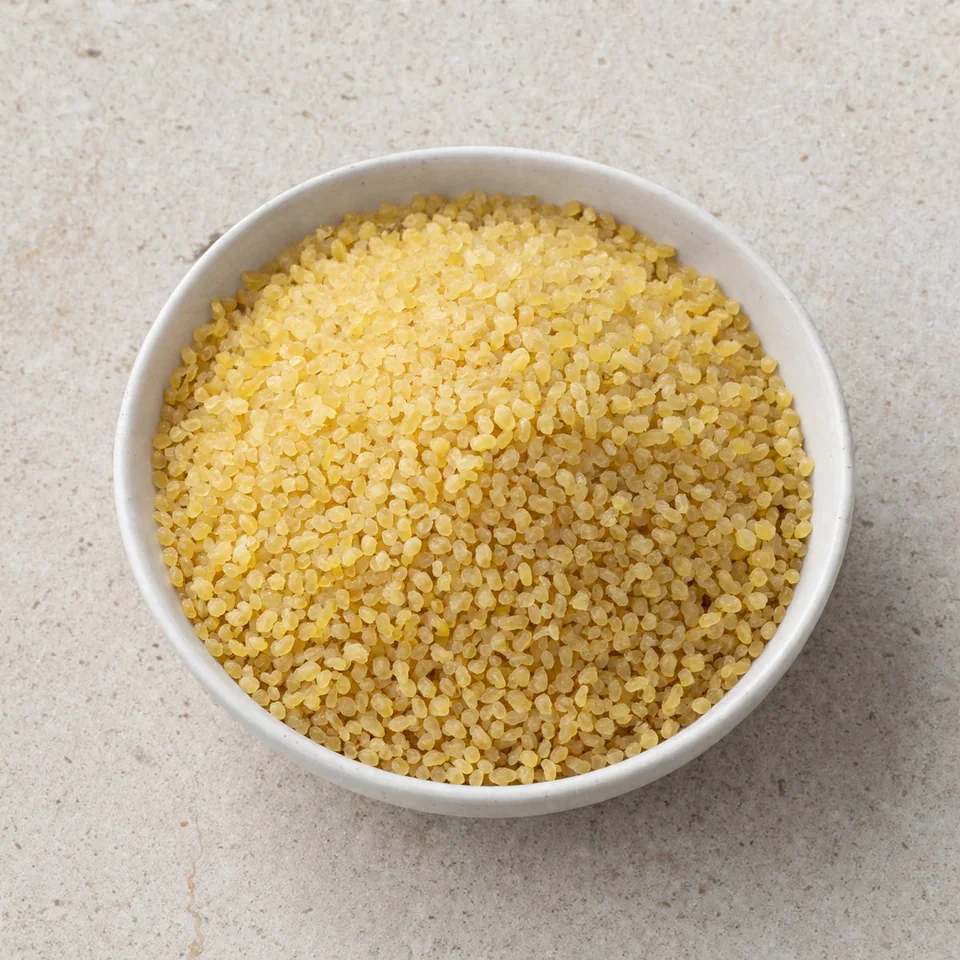
- Dry bulgur wheat
- Measurement basis
- Per 100 g dry bulgur, before rehydration or preparation
- Energy (kcal)
- 372 kcal
- Protein1
- 11.7563 g
- Carbohydrates1
- 75.8818 g
- Fat1
- 2.421 g
- Dietary fiber1
- 11.72 g
- Sugars
- 0.41 g
- Saturated fat
- 0.232 g
- Sodium1
- 2.18 mg
More nutrients26
- Energy (kJ)
- 1557.9 kJ
- Added sugars
- 0 g
- Trans fat
- 0.00144 g
- Cholesterol
- 0 mg
- Calcium1
- 34.11 mg
- Potassium1
- 358.3 mg
- Magnesium1
- 118.9 mg
- Iron
- 2.62 mg
- Zinc1
- 2.149 mg
- Vitamin B11
- 0.2263 mg
- Vitamin B2
- 0.115 mg
- Vitamin B31
- 5.18 mg
- Vitamin B5
- 1.04 mg
- Vitamin B61
- 0.2228 mg
- Vitamin B71
- 5.475 µg
- Vitamin B9 (folate)
- 27 µg
- Vitamin B12
- 0 µg
- Vitamin C
- 0 mg
- Vitamin D2
- 0 µg
- Vitamin A (RAE)
- 0 µg
- Retinol2
- 0 µg
- Beta-carotene
- 5 µg
- Alpha-carotene
- 0 µg
- Beta-cryptoxanthin
- 0 µg
- Vitamin E (alpha-tocopherol)
- 0.06 mg
- Vitamin K1 (phylloquinone)
- 1.9 µg
- Assumed zero by source
- Additional data source[1]