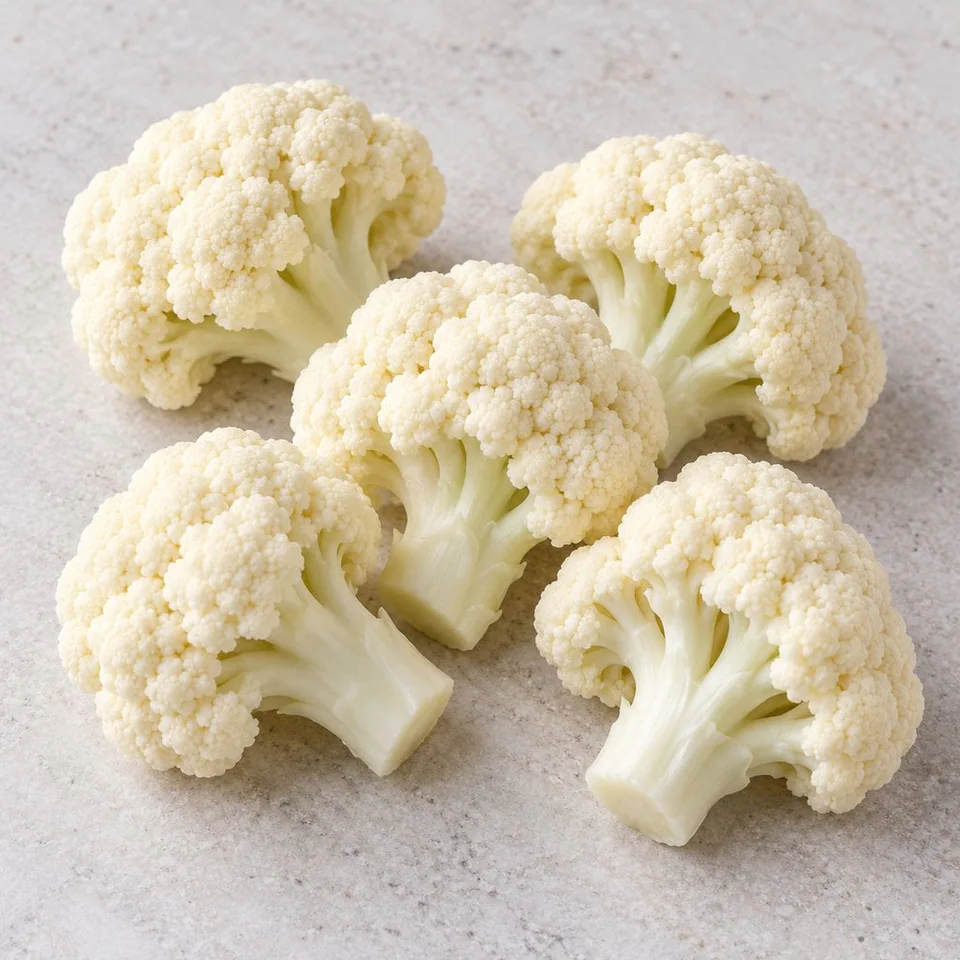
Cauliflower is a mild, white cruciferous vegetable with tightly packed florets, eaten raw or cooked. Per 100 g it provides 25 calories with 5 g carbs and 2 g fiber.
Cauliflower is a mild, white cruciferous vegetable made up of tightly packed florets on a central stem. It is eaten raw as a snack or in salads, and cooked by steaming, roasting, or boiling, and is often used as a lower-carb substitute for rice or potato.
Nutritionally, cauliflower is low in calories and mostly water. Per 100 g it provides about 25 kcal, 5 g of carbohydrates, 1.9 g of protein, and 0.3 g of fat, with 2 g of dietary fiber, 30 mg of sodium, and 22 mg of calcium.
Cauliflower can be eaten raw or cooked, and its florets hold their shape well. For accurate tracking, weigh the florets or measure by the cup, and use the serving sizes below.
Plan your portion
How much is in your serving of Cauliflower?
Nutrition values are reported per 100 g. A typical 1 cup of chopped cauliflower (about 107 g) provides roughly 27 kcal. Use the serving sizes below to estimate portions when logging.
Calculated from the per-100-g reference. Values are rounded.
Serving
Weight
Calories
Carbs
Protein
Fat
100 g
100 g
25 kcal
5 g
1.9 g
0.3 g
1 cup chopped
107 g
26.8 kcal
5.3 g
2.1 g
0.3 g
3 oz
85 g
21.3 kcal
4.2 g
1.6 g
0.2 g
Use the weight of the edible portion in the food state shown above.
Energy (kcal)
25 kcal
Energy (kJ)
104.6 kJ
Protein
1.92 g
Carbohydrates
4.97 g
Fat
0.28 g
Dietary fiber
2 g
Sugars
1.91 g
Saturated fat
0.13 g
Cholesterol
0 mg
Sodium
30 mg
Calcium
22 mg
Potassium
299 mg
Magnesium
15 mg
Iron
0.42 mg
Zinc
0.27 mg
Vitamin B1
0.05 mg
Vitamin B2
0.06 mg
Vitamin B3
0.507 mg
Vitamin B6
0.184 mg
Vitamin B9 (folate)
57 µg
Vitamin B12
0 µg
Vitamin C
48.2 mg
Vitamin D
0 µg
Vitamin A (RAE)
0 µg
Retinol
0 µg
Beta-carotene
0 µg
Alpha-carotene
0 µg
Beta-cryptoxanthin
0 µg
Vitamin E (alpha-tocopherol)
0.08 mg
Vitamin K1 (phylloquinone)
15.5 µg
Questions and answers
Cauliflower nutrition FAQ
How many calories are in cauliflower?
Cauliflower provides about 25 calories per 100 g. A typical 1 cup of chopped cauliflower (about 107 g) provides roughly 27 calories.
Is cauliflower low in carbs?
Yes. Cauliflower provides about 5 g of carbohydrates per 100 g, which is low compared with starchy vegetables like potato.
Can you eat cauliflower raw?
Yes. Cauliflower is mild and crunchy raw, and can also be steamed, roasted, or boiled.