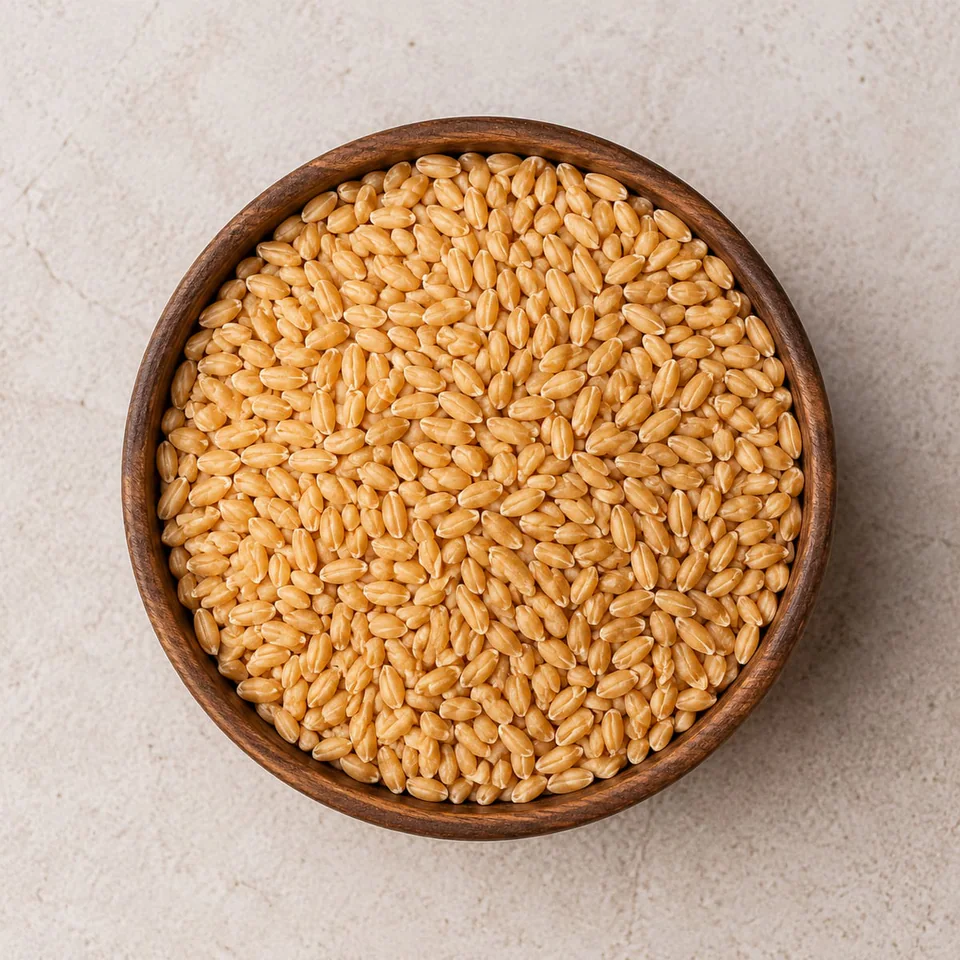
Khorasan wheat is an ancient variety of wheat with large grains and a rich, buttery flavor. It is often sold under the brand name Kamut and is used in breads, pasta, and grain dishes.
Nutritionally, khorasan wheat is rich in carbohydrates and protein. Per 100 g of dry grain it provides about 371 kcal, 71.8 g of carbohydrates, 14.8 g of protein, 2.8 g of fat, and 10.5 g of dietary fiber.
Khorasan wheat contains gluten, so it is not suitable for people with celiac disease. Use the serving sizes below to estimate portions when logging.
Plan your portion
How much is in your serving of Khorasan Wheat?
Nutrition values are reported per 100 g of dry grain. A typical cup of dry khorasan wheat (about 172 g) provides roughly 639 kcal. Use the serving sizes below to estimate portions when logging.
Calculated from the per-100-g reference. Values are rounded.
Serving
Weight
Calories
Carbs
Protein
Fat
100 g
100 g
371.4 kcal
71.8 g
14.8 g
2.8 g
1 cup dry
172 g
638.8 kcal
123.5 g
25.4 g
4.8 g
1/2 cup dry
86 g
319.4 kcal
61.7 g
12.7 g
2.4 g
Use the weight of the edible portion in the food state shown above.
Energy (kcal)
371.4 kcal
Energy (kJ)
1553.9 kJ
Protein
14.7557 g
Carbohydrates
71.7943 g
Fat
2.8 g
Dietary fiber
10.52 g
Sodium
3.936 mg
Calcium
24.08 mg
Potassium
450 mg
Magnesium
130.1 mg
Iron
3.874 mg
Zinc
4.46 mg
Vitamin B1
0.4775 mg
Vitamin B3
6.659 mg
Vitamin B6
0.258 mg
Vitamin B7
7.35 µg
Questions and answers
Khorasan Wheat nutrition FAQ
How many calories are in khorasan wheat?
Khorasan wheat provides about 371 calories per 100 g of dry grain.
Is khorasan wheat high in protein?
Khorasan wheat provides about 14.8 g of protein per 100 g.
Is khorasan wheat gluten-free?
No. Khorasan wheat is a type of wheat and contains gluten.