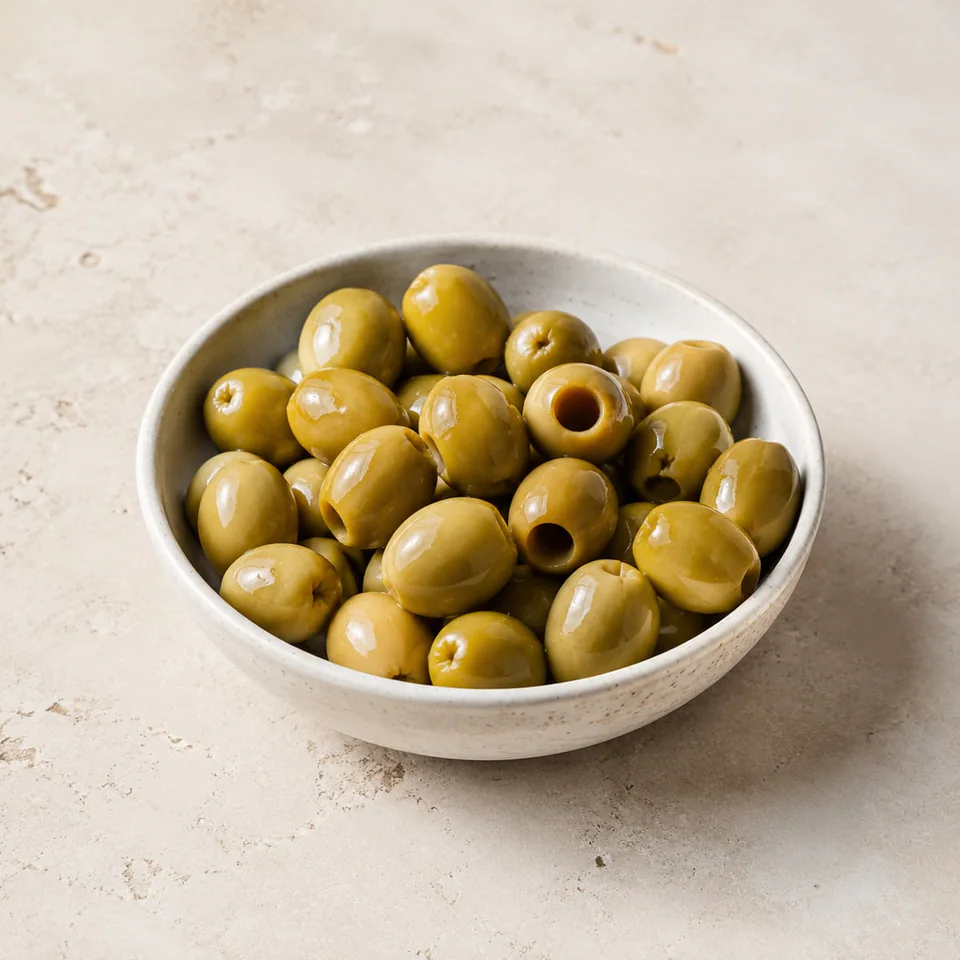
Olives (pimiento stuffed). Preparation: brined, ready to eat. Use the amount you eat; weigh the edible portion.
Plan your portion
How much is in your serving of Olives (pimiento stuffed)?
Nutrition values are reported per 100 g. A typical serving of 5 olives (about 15 g) provides roughly 20 kcal. Use the serving sizes below to estimate portions when logging.
Calculated from the per-100-g reference. Values are rounded.
Serving
Weight
Calories
Carbs
Protein
Fat
100 g
100 g
130 kcal
5 g
1.2 g
12.9 g
5 olives
15 g
19.5 kcal
0.7 g
0.2 g
1.9 g
10 olives
30 g
39 kcal
1.5 g
0.3 g
3.9 g
Use the weight of the edible portion in the food state shown above.
Energy (kcal)
130 kcal
Energy (kJ)
543 kJ
Protein
1.15 g
Carbohydrates
4.96 g
Fat
12.9 g
Dietary fiber
4 g
Sugars
0 g
Saturated fat
2.3 g
Trans fat
0 g
Sodium
1620 mg
Calcium
121 mg
Potassium
43 mg
Magnesium
12.4 mg
Iron
0.31 mg
Zinc
0.09 mg
Vitamin B1
0.041 mg
Vitamin B2
0 mg
Vitamin B3
0.103 mg
Vitamin B5
0 mg
Vitamin B6
0 mg
Vitamin B9 (folate)
0 µg
Vitamin C
0 mg
Vitamin A (RAE)
25 µg
Beta-carotene
272 µg
Alpha-carotene
2 µg
Beta-cryptoxanthin
48 µg
Vitamin E (alpha-tocopherol)
3.78 mg
Vitamin K1 (phylloquinone)
16.6 µg
Questions and answers
Olives (pimiento stuffed) nutrition FAQ
How many calories are in olives?
Olives provide about 130 calories per 100 g. A typical serving of 5 olives (about 15 g) provides roughly 20 calories.
Are olives high in fat?
Yes. Olives provide about 12.9 g of fat per 100 g, mostly monounsaturated.
Are olives high in sodium?
Yes. Brined olives provide about 1620 mg of sodium per 100 g.