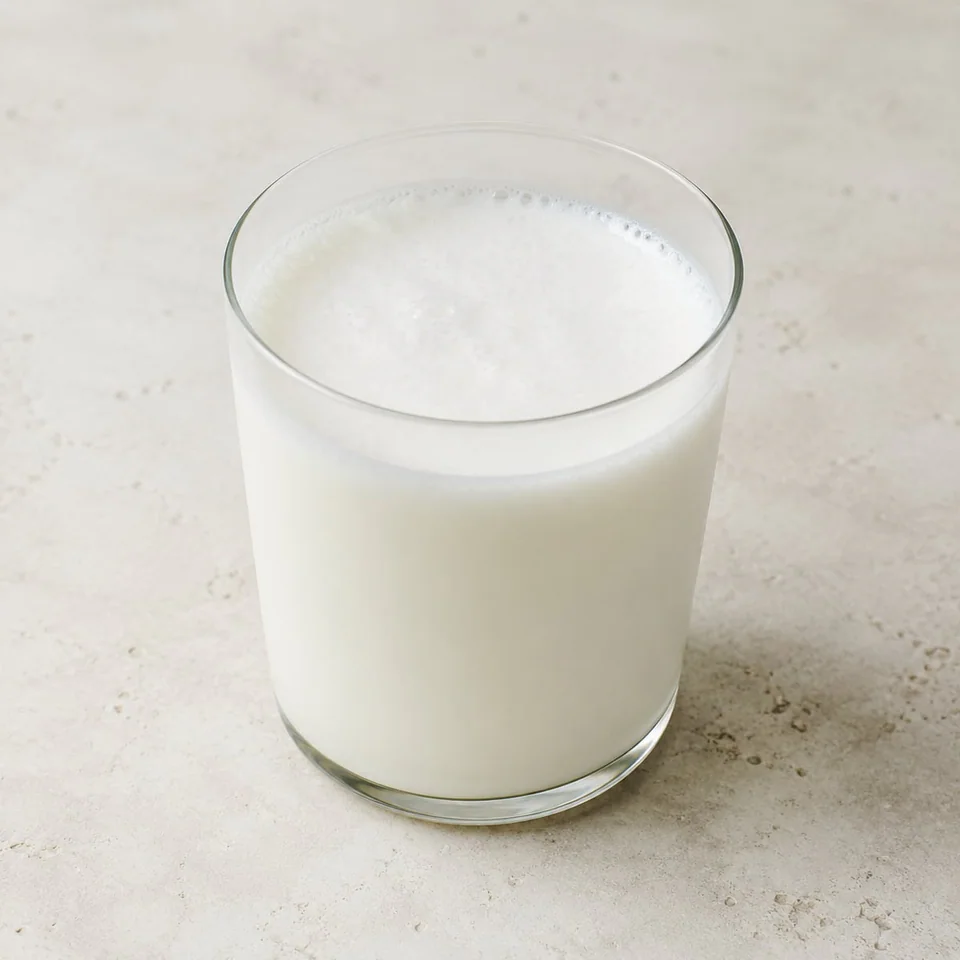
Buttermilk is a tangy, cultured dairy beverage traditionally left over after churning butter. It is commonly used in baking, marinades, and salad dressings.
Nutritionally, buttermilk is low in fat. Per 100 ml it provides about 43 kcal, 4.8 g of carbohydrates, 3.5 g of protein, and 1.1 g of fat. It also provides about 120 mg of calcium per 100 ml.
Buttermilk is often used as an ingredient rather than drunk on its own. Use the serving sizes below to estimate portions when logging.
Planifiez votre portion
Quelle quantité contient votre portion de Buttermilk?
Nutrition values are reported per 100 ml. A typical cup (240 ml) provides roughly 103 kcal. Use the serving sizes below to estimate portions when logging.
100 ml: 100 ml. A serving amount in g est nécessaire pour calculer la nutrition de cette portion.
1 cup: 240 ml. A serving amount in g est nécessaire pour calculer la nutrition de cette portion.
1/2 cup: 120 ml. A serving amount in g est nécessaire pour calculer la nutrition de cette portion.
Utilisez le poids de la partie comestible dans l'état de l'aliment indiqué ci-dessus.
Énergie (kcal)
42.8 kcal
Énergie (kJ)
179.2 kJ
Protéines
3.46 g
Glucides
4.81 g
Graisse
1.08 g
Fibres alimentaires
0 g
Acides gras saturés
0.552 g
Cholestérol
4.79 mg
Sodium
92.5 mg
Calcium
120.1 mg
Potassium
158 mg
Magnésium
11 mg
Fer
0.013 mg
Zinc
0.426 mg
Vitamine B1
0.049 mg
Vitamine B2
0.196 mg
Vitamine B3
0.128 mg
Vitamine B6
0.039 mg
Vitamine B7
0 µg
Vitamine D
0.543 µg
Rétinol
36 µg
Vitamine K2 (MK-4)
0.3 µg
Questions et réponses
Buttermilk FAQ nutrition
How many calories are in buttermilk?
Buttermilk provides about 43 calories per 100 ml. A typical cup (240 ml) provides roughly 103 calories.
Is buttermilk low in fat?
Yes. Buttermilk provides only about 1.1 g of fat per 100 ml.
How much protein is in buttermilk?
Buttermilk provides about 3.5 g of protein per 100 ml.