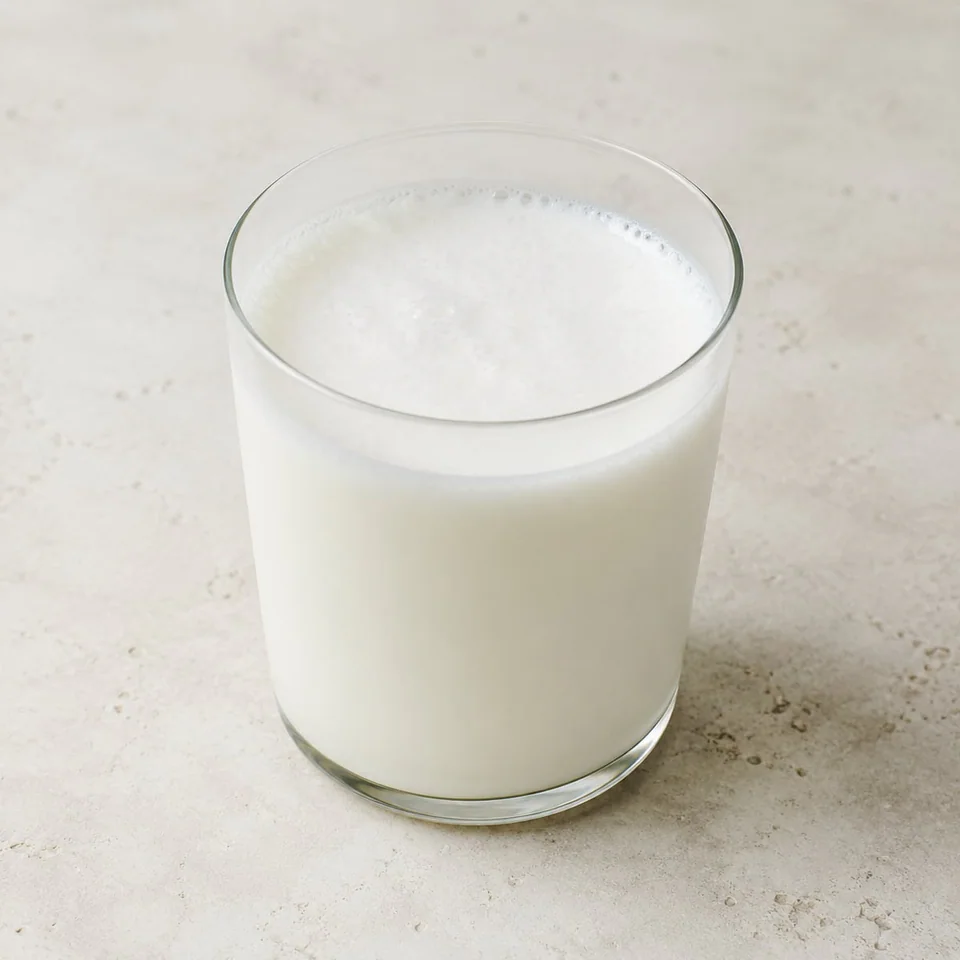
Buttermilk is a tangy, cultured dairy beverage traditionally left over after churning butter. It is commonly used in baking, marinades, and salad dressings.
Nutritionally, buttermilk is low in fat. Per 100 ml it provides about 43 kcal, 4.8 g of carbohydrates, 3.5 g of protein, and 1.1 g of fat. It also provides about 120 mg of calcium per 100 ml.
Buttermilk is often used as an ingredient rather than drunk on its own. Use the serving sizes below to estimate portions when logging.
Plan your portion
How much is in your serving of Buttermilk?
Nutrition values are reported per 100 ml. A typical cup (240 ml) provides roughly 103 kcal. Use the serving sizes below to estimate portions when logging.
100 ml: 100 ml. A serving amount in g is needed to calculate nutrition for this serving.
1 cup: 240 ml. A serving amount in g is needed to calculate nutrition for this serving.
1/2 cup: 120 ml. A serving amount in g is needed to calculate nutrition for this serving.
Use the weight of the edible portion in the food state shown above.
Energy (kcal)
42.8 kcal
Energy (kJ)
179.2 kJ
Protein
3.46 g
Carbohydrates
4.81 g
Fat
1.08 g
Dietary fiber
0 g
Saturated fat
0.552 g
Cholesterol
4.79 mg
Sodium
92.5 mg
Calcium
120.1 mg
Potassium
158 mg
Magnesium
11 mg
Iron
0.013 mg
Zinc
0.426 mg
Vitamin B1
0.049 mg
Vitamin B2
0.196 mg
Vitamin B3
0.128 mg
Vitamin B6
0.039 mg
Vitamin B7
0 µg
Vitamin D
0.543 µg
Retinol
36 µg
Vitamin K2 (MK-4)
0.3 µg
Questions and answers
Buttermilk nutrition FAQ
How many calories are in buttermilk?
Buttermilk provides about 43 calories per 100 ml. A typical cup (240 ml) provides roughly 103 calories.
Is buttermilk low in fat?
Yes. Buttermilk provides only about 1.1 g of fat per 100 ml.
How much protein is in buttermilk?
Buttermilk provides about 3.5 g of protein per 100 ml.