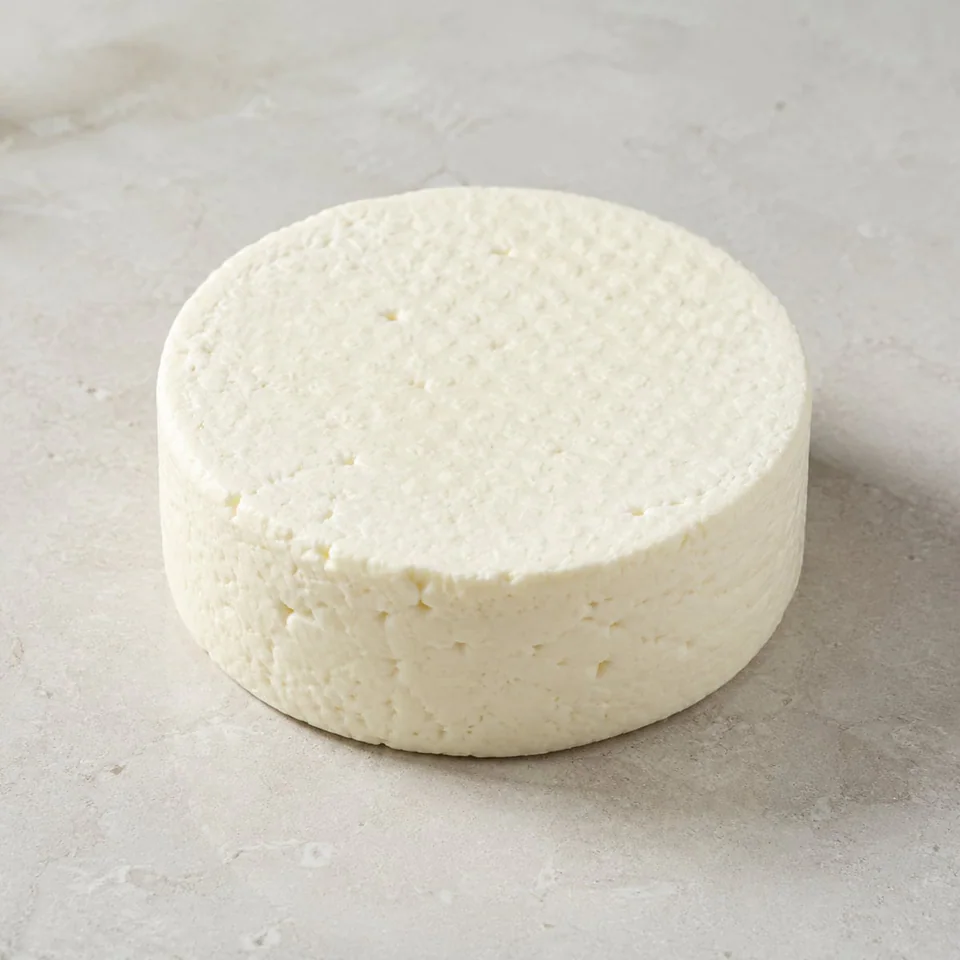
Queso seco is a firm, dry, salty cheese common in Latin American cooking. It is crumbled or grated over beans, salads, and savory dishes, and does not melt easily.
Nutritionally, queso seco is high in protein and quite salty. Per 100 g it provides about 326 kcal, 2.1 g of carbohydrates, 24.5 g of protein, and 24.3 g of fat, with 1810 mg of sodium and 661 mg of calcium.
Queso seco is calorie-dense and high in sodium. For accurate tracking, weigh or crumble the cheese, and use the serving sizes below.
Plan your portion
How much is in your serving of Queso Seco?
Nutrition values are reported per 100 g. A typical 1 oz serving (about 28 g) provides roughly 91 kcal. Use the serving sizes below to estimate portions when logging.
Calculated from the per-100-g reference. Values are rounded.
Serving
Weight
Calories
Carbs
Protein
Fat
100 g
100 g
326 kcal
2.1 g
24.5 g
24.3 g
1 oz
28 g
91.3 kcal
0.6 g
6.9 g
6.8 g
2 tbsp crumbled
20 g
65.2 kcal
0.4 g
4.9 g
4.9 g
Use the weight of the edible portion in the food state shown above.
Energy (kcal)
326 kcal
Energy (kJ)
1360 kJ
Protein
24.5 g
Carbohydrates
2.07 g
Fat
24.3 g
Dietary fiber
0 g
Sugars
0.43 g
Saturated fat
13.7 g
Trans fat
0.877 g
Cholesterol
78 mg
Sodium
1810 mg
Calcium
661 mg
Potassium
116 mg
Magnesium
26.7 mg
Iron
0.18 mg
Zinc
3.28 mg
Vitamin B1
0.038 mg
Vitamin B2
0.23 mg
Vitamin B3
0.083 mg
Vitamin B5
0.398 mg
Vitamin B6
0.091 mg
Vitamin B12
1.7 µg
Vitamin D
1.8 µg
Vitamin A (RAE)
226 µg
Retinol
223 µg
Beta-carotene
33 µg
Alpha-carotene
0 µg
Beta-cryptoxanthin
2 µg
Vitamin E (alpha-tocopherol)
0.49 mg
Vitamin K1 (phylloquinone)
1.6 µg
Vitamin K2 (MK-4)
5.9 µg
Questions and answers
Queso Seco nutrition FAQ
How many calories are in queso seco?
Queso seco provides about 326 calories per 100 g. A typical 1 oz serving (about 28 g) provides roughly 91 calories.
Is queso seco high in sodium?
Yes. Queso seco provides about 1810 mg of sodium per 100 g.
How is queso seco used?
Queso seco is crumbled or grated over beans, salads, and savory dishes, and does not melt easily.