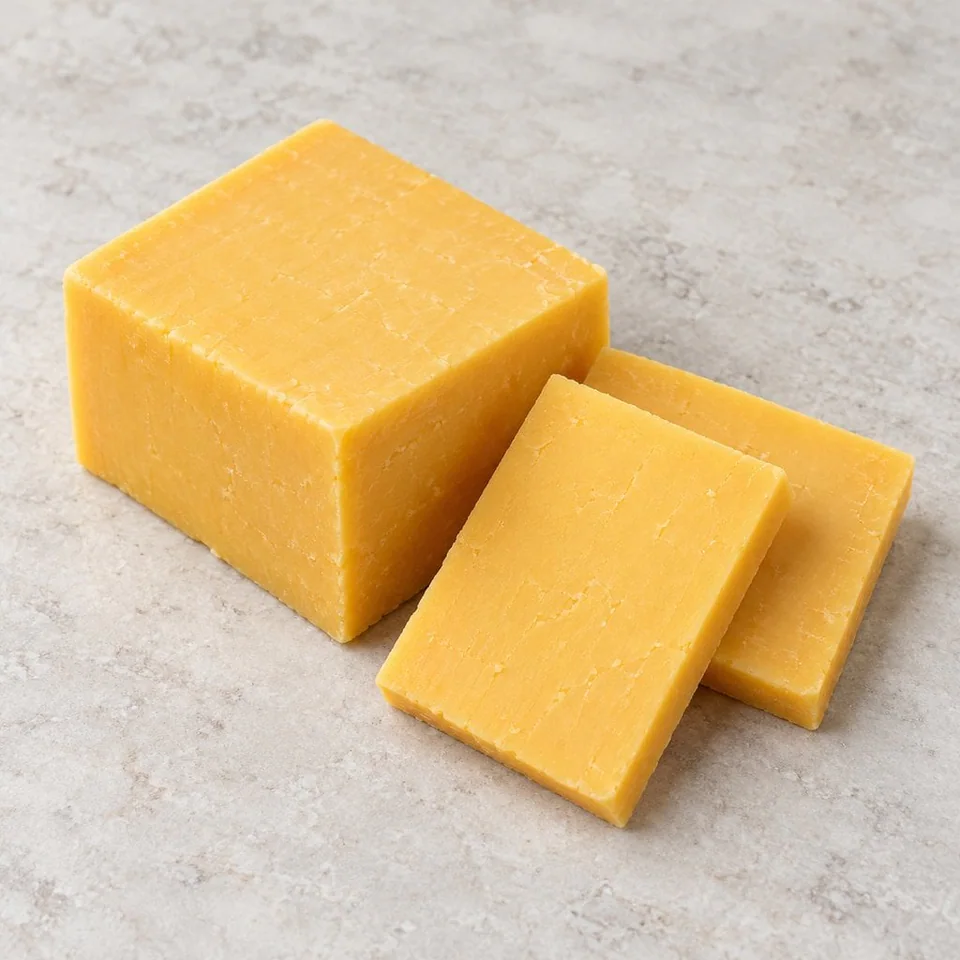
A reference for common cheese. The USDA profile combines cheddar and American cheese; individual products vary.
Plan your portion
How much is in your serving of Cheese?
Nutrition values are reported per 100 g. A typical 1 oz serving (about 28 g) provides roughly 107 kcal. Use the serving sizes below to estimate portions when logging.
Calculated from the per-100-g reference. Values are rounded.
Serving
Weight
Calories
Carbs
Protein
Fat
100 g
100 g
381 kcal
4.3 g
20.7 g
31.3 g
1 oz
28 g
106.7 kcal
1.2 g
5.8 g
8.8 g
1 slice
21 g
80 kcal
0.9 g
4.3 g
6.6 g
Use the weight of the edible portion in the food state shown above.
Energy (kcal)
381 kcal
Energy (kJ)
1594.1 kJ
Protein
20.7 g
Carbohydrates
4.3 g
Fat
31.3 g
Dietary fiber
0 g
Sugars
2.08 g
Saturated fat
17.8 g
Cholesterol
95 mg
Sodium
964 mg
Calcium
849 mg
Potassium
129 mg
Magnesium
28 mg
Iron
0.39 mg
Zinc
3.15 mg
Vitamin B1
0.029 mg
Vitamin B2
0.399 mg
Vitamin B3
0.084 mg
Vitamin B6
0.077 mg
Vitamin B9 (folate)
18 µg
Vitamin B12
1.23 µg
Vitamin C
0 mg
Vitamin D
3 µg
Vitamin A (RAE)
294 µg
Retinol
289 µg
Beta-carotene
55 µg
Alpha-carotene
0 µg
Beta-cryptoxanthin
5 µg
Vitamin E (alpha-tocopherol)
0.78 mg
Vitamin K1 (phylloquinone)
2.7 µg
Questions and answers
Cheese nutrition FAQ
How many calories are in cheese?
This common-cheese reference provides 381 kcal per 100 g. A 28 g serving provides about 107 kcal.
How much calcium does this cheese reference contain?
It provides 849 mg of calcium per 100 g. The amount varies by cheese type; choose a specific cheese entry or package label when available.
How much fat does this cheese reference contain?
It provides 31.3 g of fat per 100 g, or about 8.8 g in a 28 g serving.